Newsroom
IHB Granted Hubei's First Zebrafish Lab Animal License
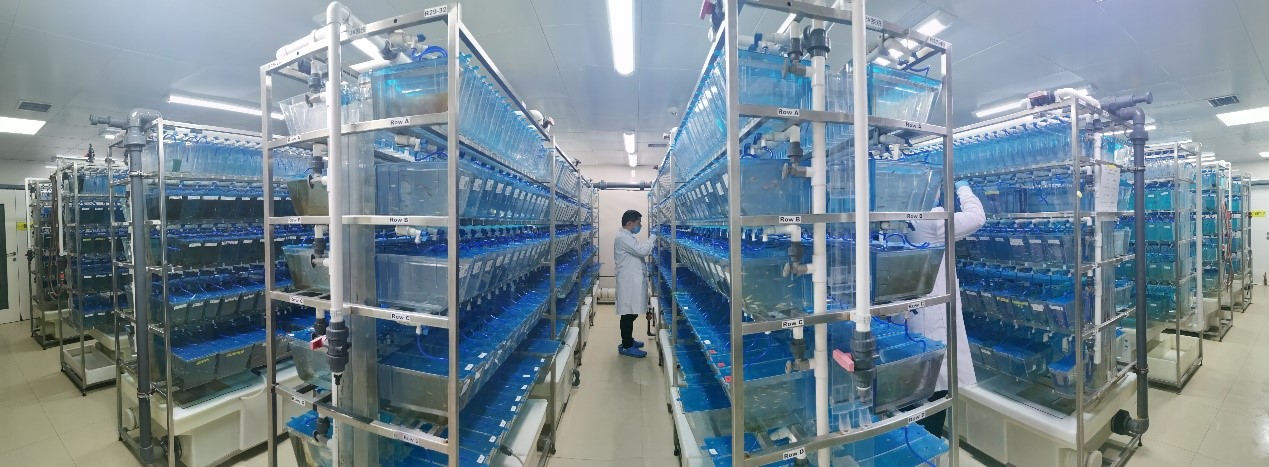
China Zebrafish Resource Center - Zebrafish Facility (Crdit: IHB)
The Hubei Provincial Department of Science and Technology recently officially issued the "Administrative License Decision for Laboratory Animals", awarding licenses for the production and use of conventional-grade zebrafish to the Institute of Hydrobiology (IHB) of the Chinese Academy of Sciences. This marks the first time zebrafish, or any experimental fish species, have been granted administrative licensing for laboratory animals in Hubei Province. It signifies a breakthrough in the construction of a standardized management system for aquatic laboratory animals in the region and establishes an institutional foundation for the standardized development of zebrafish research in Hubei.
The zebrafish is an omnivorous tropical freshwater fish native to the Indian subcontinent. Since being introduced into biological laboratories in the 1950s, it has gradually become a classic model organism. Due to its small size, rapid development, external fertilization, transparent embryos, and high genomic homology with humans, zebrafish are widely used in life sciences, health sciences, environmental sciences, aquaculture sciences, and other research fields. It is the most extensively used experimental fish internationally and the third most common laboratory animal after mice and rats. Currently, nearly a thousand laboratories in China utilize zebrafish. In 2024, China accounted for 41% of the global volume of zebrafish research, making it the world's leading country in this field.
China's only national-level zebrafish resource bank, the China Zebrafish Resource Center (CZRC), was established at IHB in 2012. In 2019, with this center as its core sub-bank, the National Aquatic Biological Resource Center was formed. Today, the CZRC is not only one of the top three zebrafish resource centers globally but also ranks first in the world in scientific research support capacity. The center currently maintains over 3,600 zebrafish strains, one-third of which were independently created based on domestic research needs. Beyond conventional resource preservation and sharing, the center undertakes numerous national major research projects and provides extensive support and services to the zebrafish research field, including model construction, fish disease diagnosis, technical training, data management, standard development, and public science education.
The licensing approval followed a rigorous, multi-stage standardization process. Beginning in 2024, the Hubei Provincial Department of Science and Technology conducted a thorough assessment of zebrafish research capabilities and needs across the province. This groundwork led to a pivotal meeting on April 23, 2025, where over 20 domain experts reached consensus on incorporating zebrafish into the official licensing framework and designated IHB as the inaugural institution to complete the application process.
IHB subsequently submitted a comprehensive application package in full compliance with Hubei's laboratory animal management regulations. Provincial authorities then convened an expert panel to conduct meticulous on-site evaluations of IHB's 380-square-meter animal and embryo facility. The inspection focused on critical areas including environmental controls, animal welfare protocols, biosafety measures, and documentation systems.
Following successful completion of both document review and facility inspection, the licenses were formally granted on September 19, 2025, with a five-year validity period through September 19, 2030.
HU Wei, deputy director of IHB, stated that the institute will use this licensing as an opportunity to provide higher-quality standardized zebrafish resources to the national research community through a three-tier service system connecting the "Resource Center - Universities - Enterprises."