Newsroom
Wuhan Welcomes Yangtze Finless Porpoise as Official City Mascot

On April 9, on behalf of IHB, LIANG Qiong (2nd R), dputy director of IHB, joined a municipal government press conference to share the decades-long scientific journey behind protecting this endangered species.
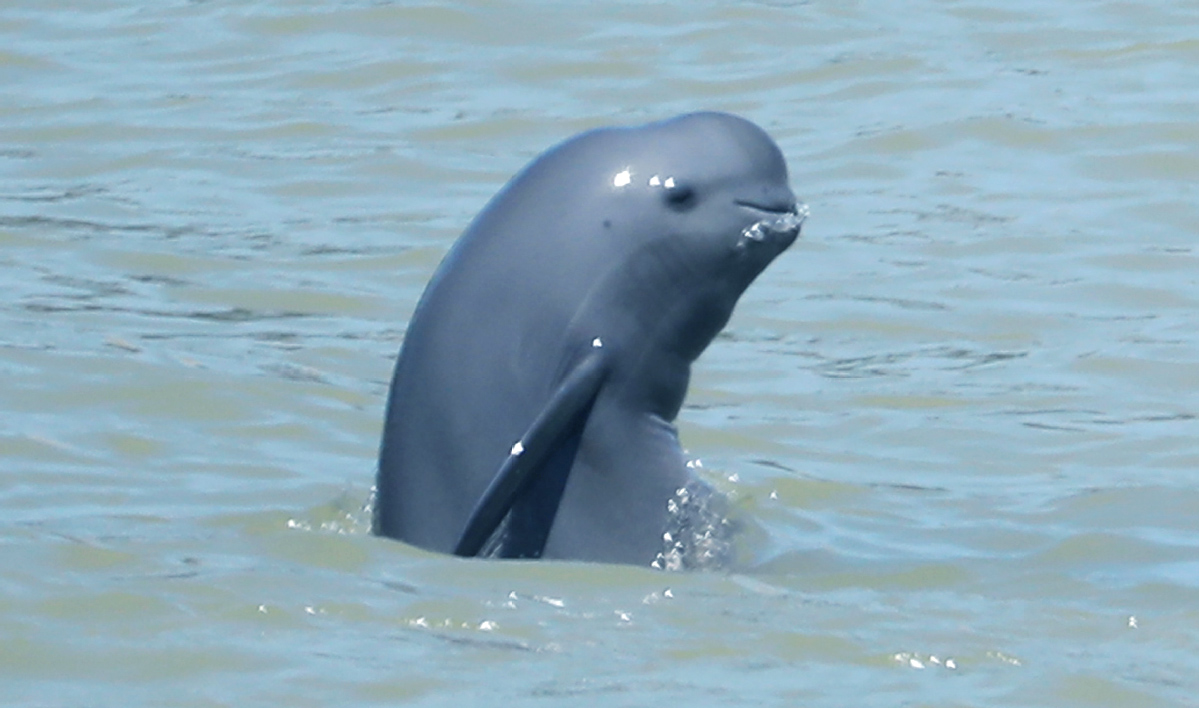
In a historic and heartwarming ceremony on April 8, 2026, the people of Wuhan officially welcomed the Yangtze finless porpoise as the city's legal mascot. From this day forward, Wuhan is represented by a “smiling angel” that embodies ecological responsibility, urban spirit, and public affection.
On April 9, the Institute of Hydrobiology (IHB) of the Chinese Academy of Sciences joined a municipal government press conference to share the decades-long scientific journey behind protecting this endangered species.
In 2022, the population of Yangtze finless porpoises reversed a historic decline, reaching 1,249 individuals. As of January 2026, the latest census shows an encouraging rise to 1,426, an increase of 177 porpoises in just over three years. These numbers stand as a powerful testament to the Yangtze River conservation effort.
Behind this success is the unwavering commitment of the IHB, recognized as the national vanguard for porpoise protection. As early as 1986, IHB scientists proposed a three-pronged strategy: in-situ conservation, ex-situ conservation, and captive breeding. This framework, later formalized in the Action Plan for Saving the Yangtze Finless Porpoise, remains the national blueprint for porpoise protection.
“With leadership from the Ministry of Agriculture and Rural Affairs, we have achieved major progress...” said Dr. Zheng Jinsong of IHB. “These efforts laid the foundation for the porpoise to become Wuhan’s mascot.” He acknowledged the essential support of the Hubei Department of Agriculture and Rural Affairs, Wuhan Bureau of Agriculture and Rural Affairs, Hubei Forestry Bureau, and the Chinese Academy of Sciences.
Few know the dedication behind these achievements. At the Baiji Dolphinarium, researchers work 24/7 shifts. A porpoise pregnancy lasts about 12 months — and one month before delivery, the team enters “emergency mode,” recording the mother’s behavior every half hour, staying awake through the night. Water temperature must be held at exactly 26°C. Feeder fish must be fresh, offered 5–6 times daily, with every morsel and movement logged.
“What I feared most was a late-night phone call,” recalled Dr. HAO Yujiang. One winter, a pregnant porpoise encountered problems during delivery. Researchers spent three days and nights in freezing water, taking turns to assist. “The cold seeped into our bones, but no one backed out.”
Rearing calves artificially is even more challenging. Some newborns don’t nurse naturally. Researchers lived at the facility for two months, rising at 4 a.m. to prepare food and observe nursing. “When a calf gets sick, we’re more worried than if our own children were ill,” said Dr. Hao.
That obsessive devotion has paid off: the world’s first naturally conceived and born captive porpoise, “Tao Tao,” thrived, followed by second-generation calves. “Every safe birth feels like a festival to us,” Dr. Hao added.
With the porpoise now officially crowned Wuhan’s mascot, IHB plans to turn professional research into clear, public-friendly conservation information..
“Guardian Porpoise Model Schools”: Ten such schools now operate along the Yangtze, where children attend “Porpoise Classrooms” to draw smiles and learn protection.
“Quiet Yangtze” public platform: An integrated acoustic-visual smart monitoring network will allow citizens to “cloud-watch” porpoises on their phones.
Conservation without borders: China’s porpoise conservation model has helped Cambodia’s Irrawaddy dolphins. U.S. schoolgirl Jessica has flown across the Pacific for ten years to volunteer in Wuhan, and French scientist Agatha now serves as an international promoter of the Yangtze finless porpoise. The porpoise’s smile has long crossed national boundaries.
Scientists emphasize that this mascot moment is not the finish line. It is the starting point for a new era of public guardianship.
Every resident can help:
Do not litter into the Yangtze; practice legal and ethical fishing.
Share the porpoise story with children, visitors, and the world.
Save water, and choose low-carbon transport.
Next time you spot that upturned smile on the Yangtze, remember: it is the heartbeat of the river, and Wuhan’s smile to the world.