Newsroom
Fifth Edition of 'Phycology' Published in Chinese with IHB's Contribution
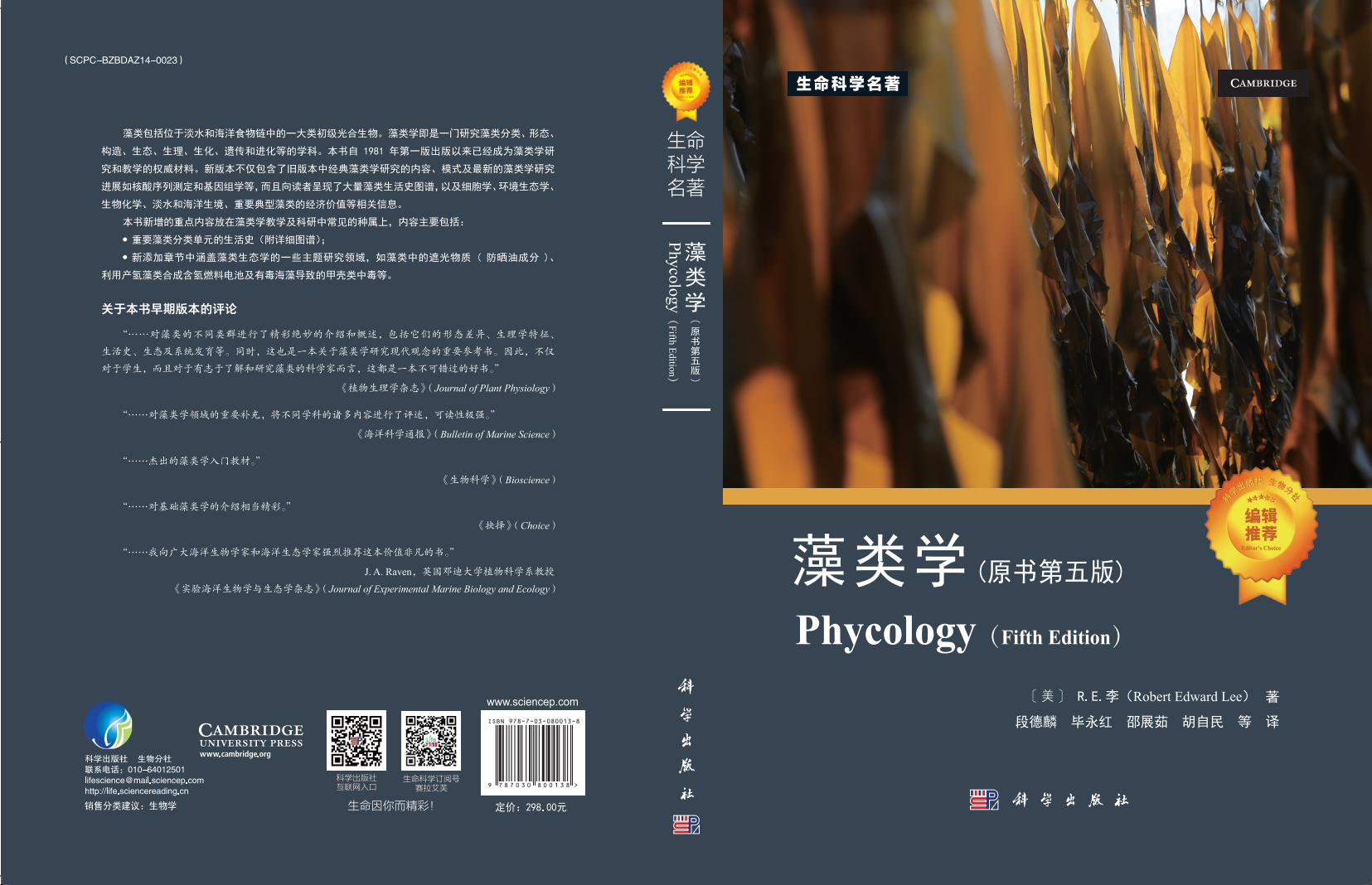
A Chinese translation of the fifth edition of Phycology, a standard textbook in the field of algae research, has been published by Science Press. The work is a collaboration between the Institute of Hydrobiology (IHB) and the Institute of Oceanology, both under the Chinese Academy of Sciences (CAS).
The book provides a systematic introduction to algae, covering their basic characteristics, cell structure, nutritional modes, evolutionary history, and classification systems. It offers comprehensive accounts of major groups includingCyanobacteria, Rhodophyta, Chlorophyta, Bacillariophyta, Euglenophyta, Dinophyta, Cryptophyta, Chrysophyta, and Phaeophyta.
A dedicated section on "Algae and the Environment" highlights the important role of algae in maintaining ecosystem structure, driving material cycles, responding to environmental change, and supporting resource use.
The translation incorporates recent advances in the field, including discussions on the potential and challenges of algal biofuels and progress in algal toxin research. It also introduces new molecular tools and techniques used to study algal origins, phylogeny, and taxonomy, giving the volume a strong academic, systematic, and practical orientation.
According to the publishers, the book aims to serve as a professional reference for university faculty, students, and researchers in phycology and related disciplines, functioning as both a textbook and a practical resource for teaching, research, and applied work.
The translation and review of all freshwater algae content was led by the research group of Prof. BI Yonghong at IHB. The team has long focused on multi-scale studies of freshwater algae, spanning molecular, cellular, population, and community levels. Their work bridges fundamental research and engineering applications.
The group's involvement in translating the fifth edition of Phycology draws on years of its own research. Team members say the work reflects their long-standing commitment to textbook development and academic knowledge-sharing. They expect the new Chinese translation to help bring classic international phycology to bear on China's freshwater protection, water environment restoration, and the use of algal resources.