Newsroom
Wuhan's Main Event for 2026 International Day for Biological Diversity Held at IHB, Showcasing Yangtze Conservation Achievements
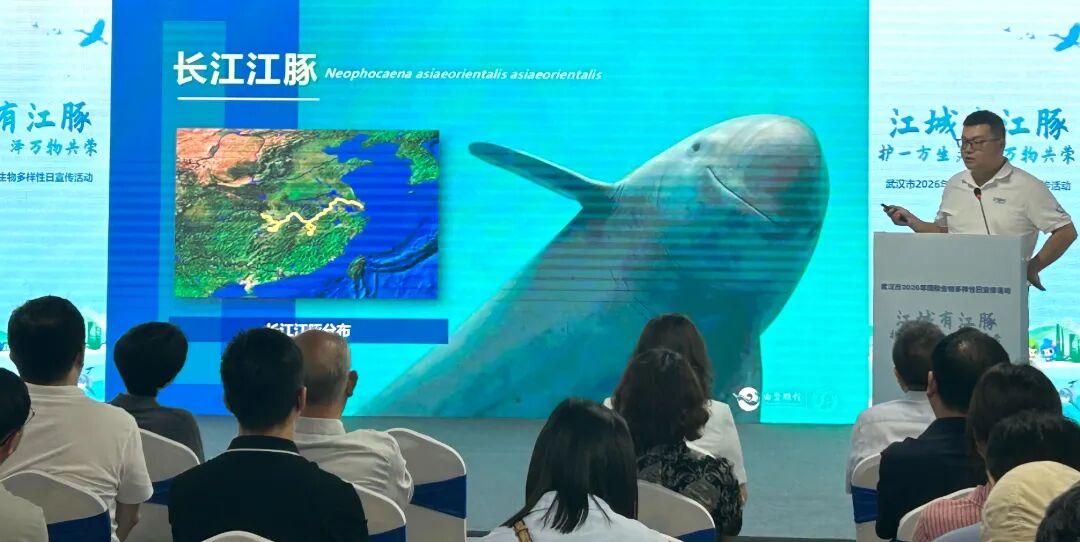
Prof. MEI Zhigang from IHB demonstrated a smart monitoring system combining underwater acoustics, aerial and surface imaging, and AI recognition. (Credit: IHB)
Provincial and municipal government departments, research institutions, social organizations, and representatives from all sectors of society gathered in Wuhan on May 22, 2026 to showcase the city's innovative practices and outcomes in advancing biodiversity conservation under the national Yangtze River protection strategy.
The event, held at the Guanqiao Campus of the Institute of Hydrobiology (IHB), Chinese Academy of Sciences, marked the city's International Day for Biological Diversity 2026. It was jointly organized by Wuhan Municipal Bureau of Ecology and Environment, Wuhan Municipal Bureau of Agriculture and Rural Affairs, Wuhan Municipal Bureau of Parks and Woodland, and the IHB. It was hosted by the Wuhan Baiji Conservation Foundation.
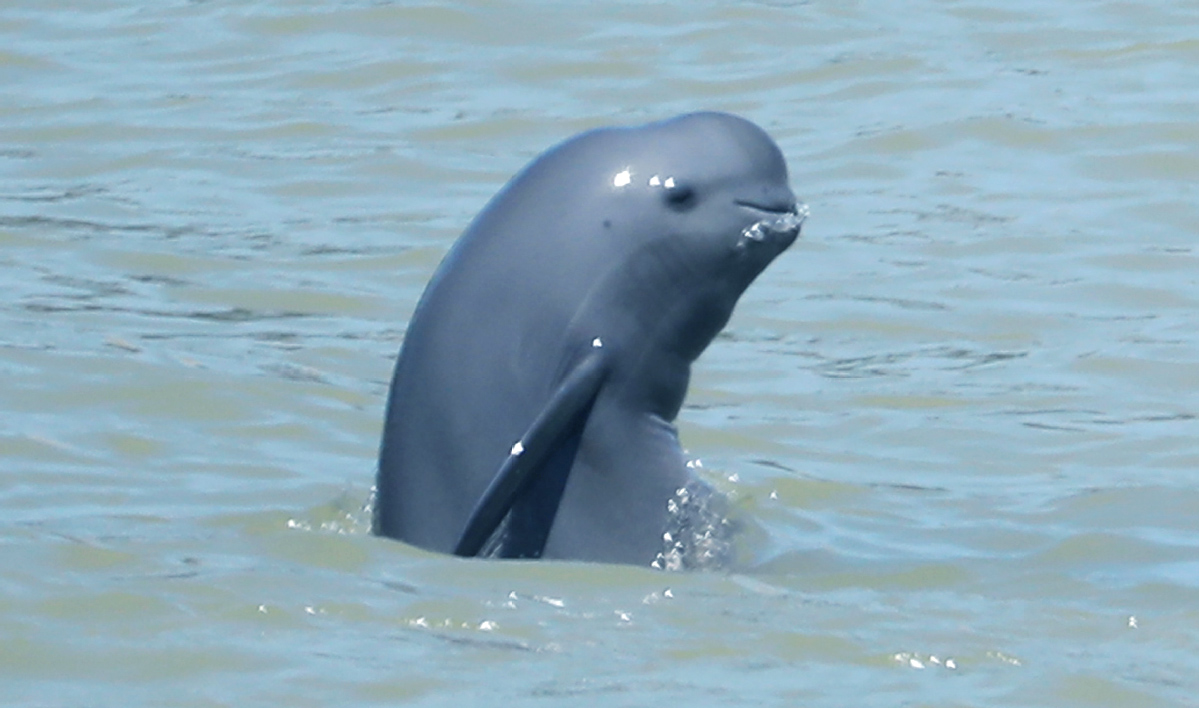
In April 2026, Wuhan became China's first megacity to designate the Yangtze finless porpoise as its official city mascot through a local legislative resolution. The legal move has shifted porpoise conservation from a purely scientific and administrative effort into a legally binding, publicly resonant and brand-driven campaign, according to officials.
Speaking at the event, TIAN Qi, a second-level inspector at the Department of Ecology and Environment of Hubei, expressed hope that Wuhan would continue to pilot legal protections, public participation, and international outreach during the 15th Five-Year Plan period (2026-2030), providing "Wuhan experience" for biodiversity conservation across the province.
XU Jun, deputy director of IHB, noted that the Yangtze River's 10-year fishing moratorium, which was first proposed by IHB Prof. CAO Wenxuan, remains central to restoring the river's aquatic biodiversity. The institute has established captive breeding populations of the Yangtze finless porpoise and exported conservation technologies to several Southeast Asian countries to support freshwater dolphin protection.
LUO Wei, deputy director of Wuhan Municipal Bureau of Ecology and Environment, said that under the city's Biodiversity Conservation Plan, a protection framework featuring "two axes, two rings and four ecological zones" has been established for the first time. "The plan lists flagship species including the Yangtze finless porpoise and the Baer's pochard as priorities for conservation," he added.
On institutional innovation, Luo said Wuhan has been working to remove administrative barriers. "The city has joined forces with cities in the middle Yangtze River agglomeration, as well as with representative cities from the 'Han-Xiang-Yi' golden triangle, namely Wuhan, Xiangyang and Yichang, to issue a joint initiative on strengthening cross-regional biodiversity protection," he told the gathering.
According to Luo, the parties have agreed to share monitoring data, build a shared database on biodiversity in the middle Yangtze region, and jointly protect the Yangtze ecological corridor. "The goal is to achieve real-time 'one-map' management of rare species and coordinated conservation across the river basin, advancing biodiversity protection from isolated site-level efforts to systemic, region-wide collaboration," he said.
Prof. MEI Zhigang from IHB demonstrated a smart monitoring system combining underwater acoustics, aerial and surface imaging, and AI recognition. The system enables 24/7 surveillance, solving long-standing challenges in detecting and tracking porpoise populations, Mei said. Official estimates now place the Yangtze finless porpoise population at 1,426 individuals, with frequent sightings in Wuhan's river sections.
The city's agriculture bureau launched a global call for visual identity designs for the porpoise mascot, which is expected to be integrated into public spaces and international exchanges.
"The porpoise has gone from a rare visitor to a frequent resident, and now a family member," said WANG Qiong, a deputy to the National People's Congress (NPC). "Its smile is the river's perfect report card."
Lina Syrimi, a doctoral student from Cyprus at IHB, has joined the "Saving the Smiling Angel" volunteer initiative. "IHB is training young scholars from Russia, Pakistan, Italy, and France, applying lessons from the Yangtze finless porpoise to help conserve other freshwater dolphin species," she said. "China's model is becoming a global solution."