
Newsroom
Study Reveals Cellular and Molecular Mechanisms Underlying Hood Formation in Goldfish
Goldfish is a Chinese national treasure originating from the amphidiploid Carassius auratus. Under long-term selective pressures from artificial domestication, mutations have occurred in the body shape, coloration, and various external traits of goldfish. Through hybridization, recombination, and artificial selection, these mutations have given rise to a thriving diversity of over 300 distinct varieties. These diverse breeds have subsequently spread to numerous countries and regions worldwide, including Japan, the United Kingdom, the United States, and Thailand, establishing the goldfish as the first ornamental fish globally known to have been domesticated and selectively bred in China. To this day, it remains one of the most popular ornamental fish species.
The diverse phenotypes of goldfish also make it an excellent model for studying genetics, developmental biology, evolutionary biology, and human diseases. With advances in genome sequencing and multi-omics analytical technologies, candidate regions for several key traits have been identified, and the causal genes and formation mechanisms for traits such as the dragon-eye and Jade Rabbit have gradually been revealed. Warty growth or hood is a unique ornamental phenotype in goldfish charactered by thickened epidermis of cranial and opercula regions. Although this mutated trait was described 100 years ago in goldfish, the primary structural features of the hood and the molecular basis underlying the developmental process is still totally unknown.
Recently, in the study published in Research, a team led by Academician GUI Jianfang from the Institute of Hydrobiology (IHB) of the Chinese Academy of Sciences, discovered that the hoods of Lion-head goldfish is essentially a cutaneous fibrotic structure rich in fibrous collagen. Further research revealed that the downregulation of arachidonic acid metabolism promotes the excessive deposition of collagen and alterations in skull structure by inducing dysregulated expression of the Tumor necrosis factor (TNF) signaling pathway, thereby driving the morphogenesis of the hoods.
The research team systematically elucidated the four-layer anatomical structure of the hood, comprising the stratum compactum, stratum spongiosum, stratum adventitia, and epithelial cell layer. Among these, the substantial deposition of collagen in the stratum spongiosum and the proliferation of the epithelial cell layer are key factors contributing to the hood’s protrusions.
Histological analysis revealed extensive accumulation of fibrous collagen and fibroblast hyperplasia within the hood. Multi-omics data further indicated up-regulation of the extracellular matrix (ECM) and glycolysis pathways, alongside down-regulation of lipid metabolism-related pathways, confirming that the hood of Lion-head goldfish constitutes a cutaneous fibrotic structure. Experimental results demonstrated that down-regulation of arachidonic acid metabolism activates an inflammatory-like response, leading to the down-regulation of the TNF signaling pathway during the rapid developmental stage of the hood. This subsequently promotes collagen deposition and induces epithelial cell proliferation, serving as a crucial driving mechanism for hood morphogenesis.
The research team discovered that during the morphogenesis of the hood in Lion-head goldfish is accompanied by irregular skull hyperplasia and abnormal bony protrusions. Experimental results confirmed the regulatory relationship between TNF and osteoclast differentiation, revealing the potential molecular mechanism of skull morphological changes in lion-headed goldfish and the structural basis conducive to the later attachment of the hood.
This study not only systematically analyzed the cellular and molecular mechanisms underlying goldfish hoods formation for the first time, providing a theoretical basis for ornamental fish trait breeding, but also offers new perspectives for the research of human fibrotic diseases.
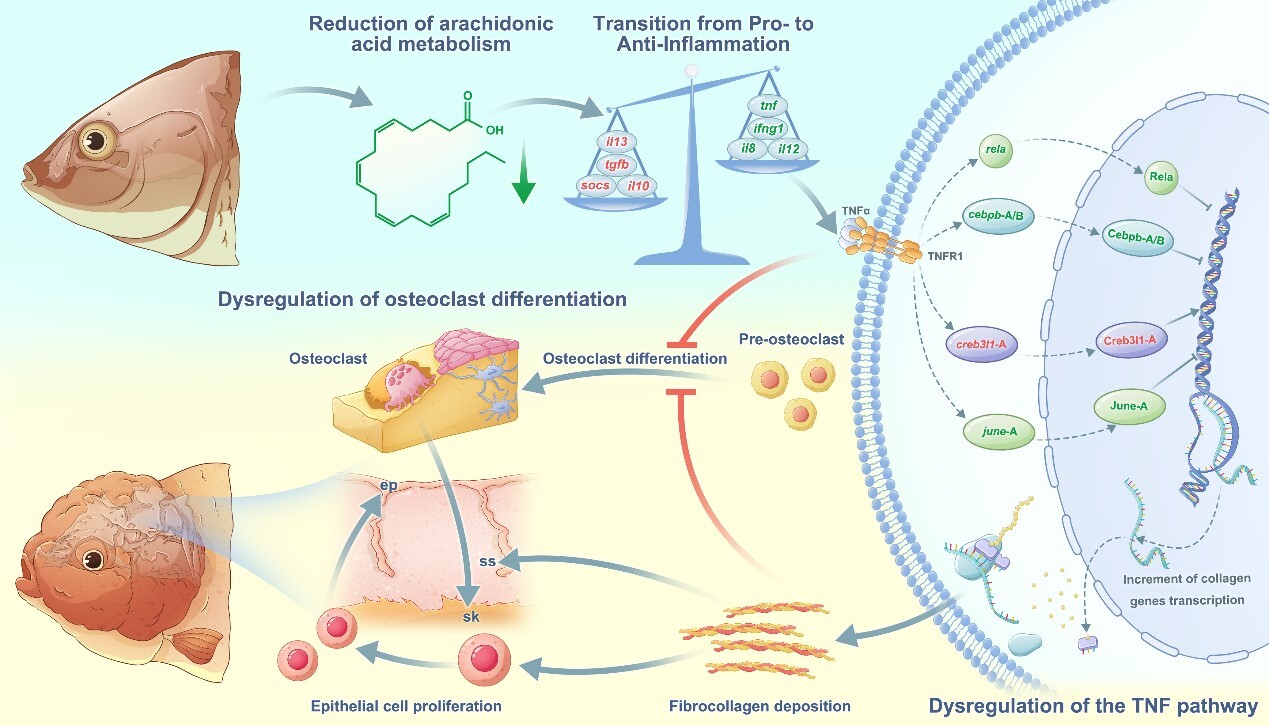
A hypothesized diagram for hood formation in Lionhead goldfish (Image by IHB)
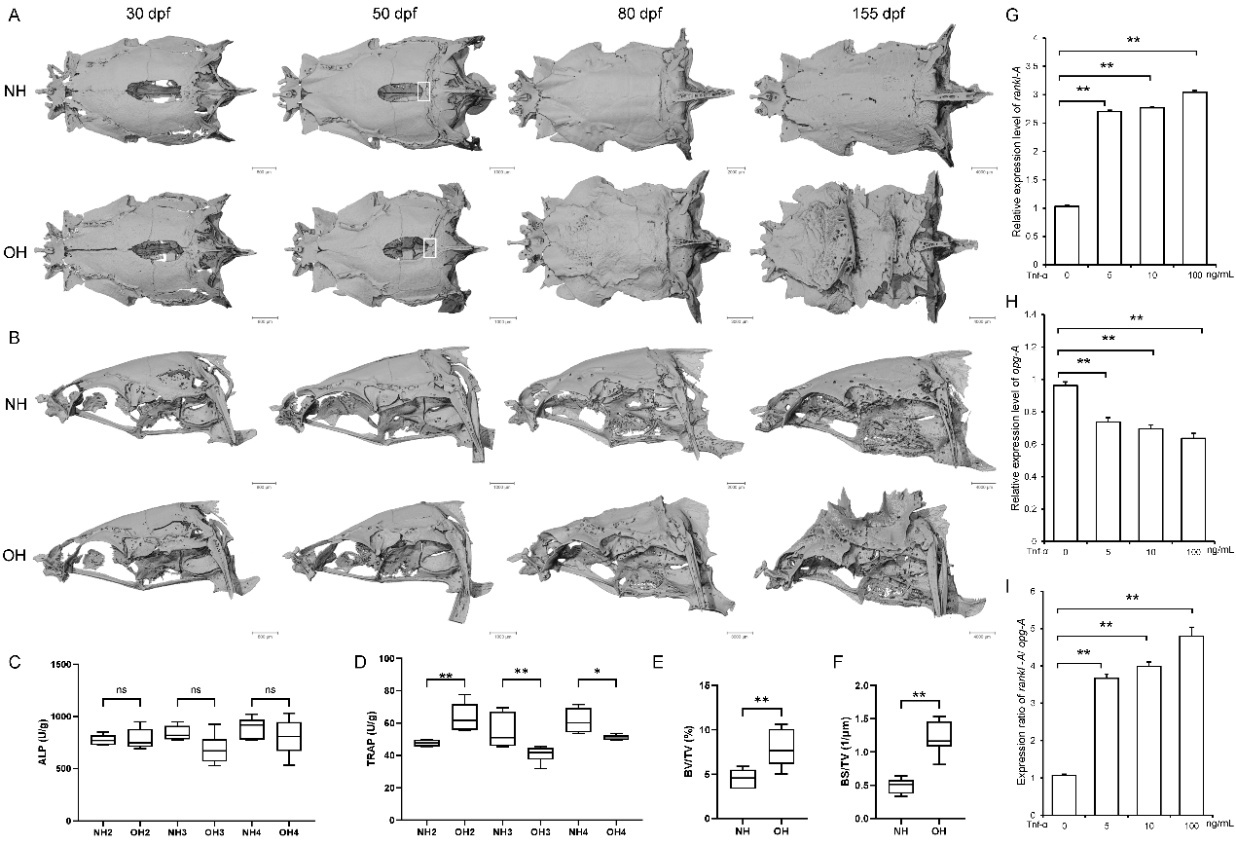
The development of the hood is accompanied by the emergence of irregular skull protrusions (Image by IHB)
(Editor: MA Yun)