Newsroom
Dilute-Acid Extracted Phosphorus Enables Multi-level Assessment of Internal Phosphorus Release Risk
Phosphorus (P) is one of the key limiting nutrients driving eutrophication in aquatic ecosystems. Even after external nutrient inputs have been effectively controlled, the continued release of bioavailable P from sediments can sustain elevated nutrient levels in the water column, thereby impeding the ecological recovery of lakes and reservoirs. Developing a simple, reliable, and ecologically meaningful method for assessing the risk of internal P release from sediments is therefore of great importance for water environment management and aquatic ecosystem restoration.
Recently, in a study published in Water Research, a research team led by Prof. LI Qingman from the Institute of Hydrobiology (IHB) of the Chinese Academy of Sciences proposes a new multi-level assessment framework for internal P release risk based on dilute-HCl extracted P (dHCl-P), providing a practical tool for sediment P risk evaluation in freshwater ecosystems.
In this study, the researchers investigated sediments collected from four representative freshwater water bodies in China, namely Honghu Lake (HL), Xiashan Reservoir (XR), Zhanghe Reservoir (ZR), and Yudong Reservoir (YR). They systematically evaluated the relationships between dHCl-P and sediment reductive type, sediment matrix type, total P content, P fraction composition, and P concentrations in the overlying water.
The results showed that dHCl-P is primarily controlled by sediment reductive type rather than by total P content or sediment matrix type alone. In particular, RedOr-Sn sediments contained substantially higher levels of dHCl-P than RedOr-Fe(II) sediments, indicating a greater potential for internal P release.
Further mechanistic analyses revealed that dHCl-P mainly consists of labile P fractions, including exchangeable P, Fe(II)-bound P, and Ca-bound P. As sediment reduction intensifies, Fe(III) oxides undergo reductive dissolution, which weakens the P retention capacity of sediments and promotes the accumulation of labile P. These findings indicate that dHCl-P is not merely an extraction-based chemical index, but also an effective indicator of P mobilization risk under redox-driven sediment processes.
The study further demonstrated that dHCl-P is significantly correlated with both total dissolved P and soluble reactive P in the overlying water. Compared with conventional indicators, dHCl-P showed a stronger capacity to reflect the sedimentary P pool that is potentially releasable to the water column.
On the basis of these findings, the research team established a four-level framework for assessing internal P release risk by integrating sediment reductive type, the proportion of dHCl-P in total P, and the reduction degree of iron oxides. This framework provides a unified and operational approach for identifying sediment P release risk across different freshwater systems and may serve as a valuable reference for the management of lakes, reservoirs, and other eutrophic waters.
This study offers a new technical pathway for internal P risk assessment in freshwater environments. By linking a simple dilute-acid extraction index with sediment redox conditions, labile P fractions, and P responses in overlying water, the work provides important support for risk identification, management prioritization, and the development of targeted remediation strategies.
The study was conducted by the Institute of Hydrobiology, Chinese Academy of Sciences, in collaboration with the Weifang Xiashan Reservoir Management Service Center and other partners.
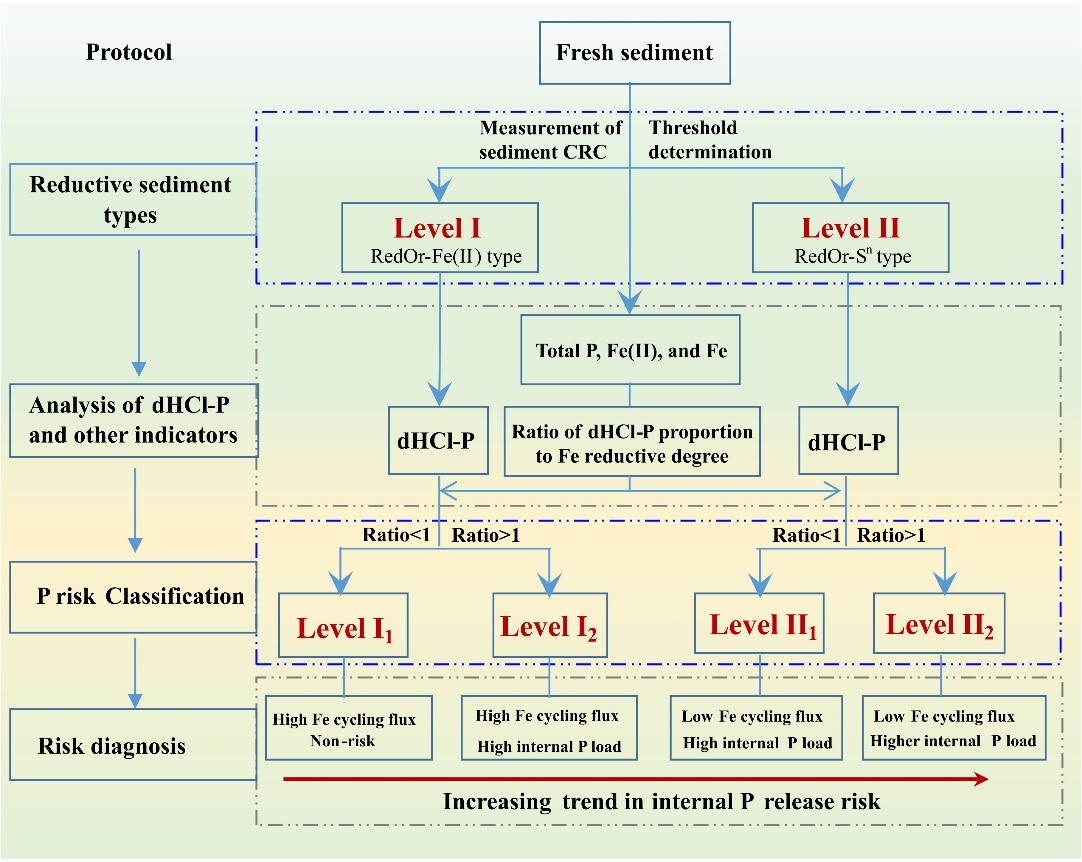
An operational framework for multi-level evaluation of sedimentary phosphorus release risks (Image by IHB)
(Editor: MA Yun)