Newsroom
Dark Diversity Offers New Insights into Freshwater Fish Invasions
Biological invasions are a major threat to freshwater biodiversity, but predicting which non-native species can establish remains difficult. A central debate is Darwin's naturalization conundrum: whether invaders succeed because they are closely related to native species and preadapted to local conditions, or because they are distantly related and face weaker competition.
Recently, researchers including XU Meng from the Institute of Hydrobiology (IHB) of the Chinese Academy of Sciences and Pearl River Fisheries Research Institute, Chinese Academy of Fishery Sciences, together with LI Shao-peng and ZHANG Wen-gang from East China Normal University and overseas institutions, introduced a dark diversity framework to address this question in freshwater fishes. The study was published in Proceedings of the National Academy of Sciences.
Dark diversity refers to species that are absent from a local community but could potentially inhabit it. By combining dark diversity with observed diversity, the framework captures both the site-specific species pool and community completeness.
Using records of successful and failed fish introductions across Swedish lakes, the researchers found that invasion outcomes depend on this ecological context. In lakes with smaller species pools and higher community completeness, non-native fishes closely related to native species were more likely to establish. In lakes with larger species pools and lower completeness, phylogenetically distant non-native fishes had an advantage.
The results suggest that species pool size and community completeness explain invasion patterns better than observed native species richness or commonly used environmental variables. This framework helps reconcile long-standing conflicting evidence and provides a practical tool for forecasting freshwater fish invasion risks and supporting ecosystem management.
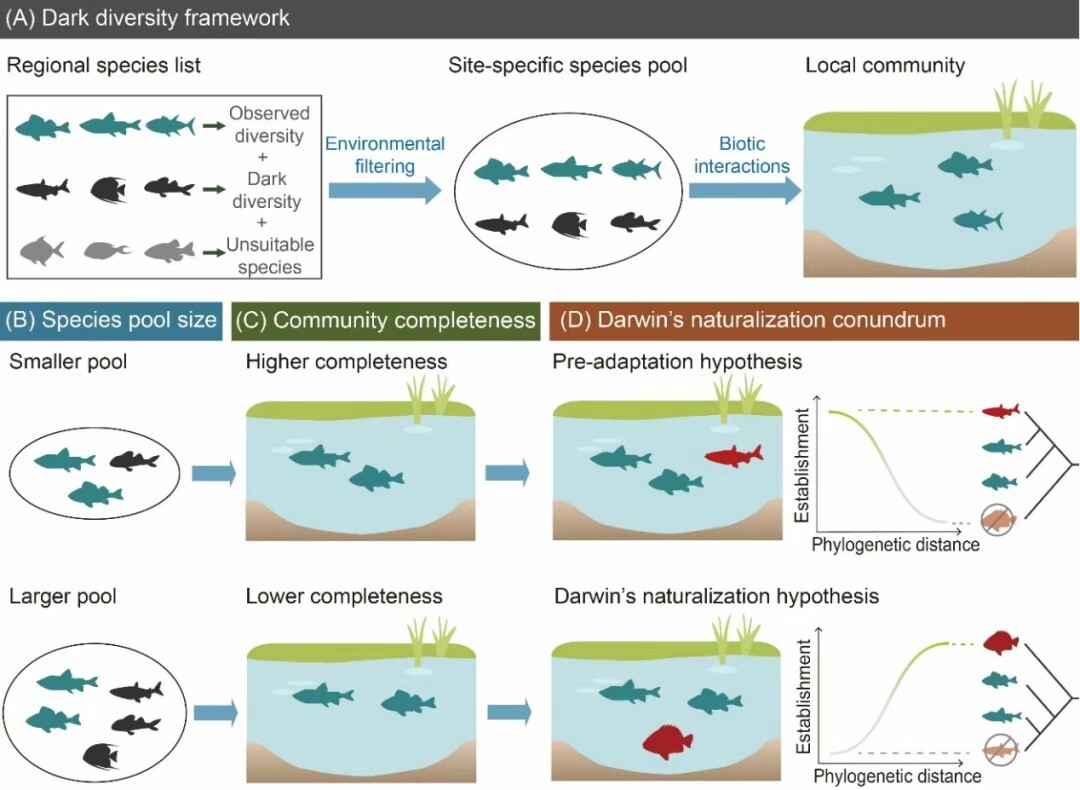
Dark diversity framework for reconciling Darwin's naturalization conundrum. Credit: Zhang et al., PNAS (2026) (Image by IHB)
(Editor: MA Yun)