Newsroom
Moderate Selective Fish Removal Triggers Synergistic Recovery in Degraded Plateau Lake
Shallow lakes worldwide are increasingly threatened by eutrophication, overfishing, and water-level fluctuations. The loss of submerged macrophytes can trigger a regime shift from a clear-water state to a turbid, phytoplankton-dominated one, degrading biodiversity and ecosystem services. Biomanipulation through selective fish removal (SFR) has been widely used for lake rehabilitation, yet evidence from highland plateau lakes has remained scarce.
Recently, a research group led by Prof. GUO Chuanbo from the Institute of Hydrobiology, Chinese Academy of Sciences, demonstrated through a whole-lake experiment that moderately intensive SFR can enhance biodiversity and trigger synergistic ecosystem recovery. The study, with Dr. ZHOU Ting as first author, was published in the Journal of Environmental Management.
The experiment was conducted in Caohai Lake, a large plateau lake in southwest China where submerged macrophyte coverage collapsed from ~70% to below 10% during 2016–2019. From February 2022 to July 2023, an SFR intervention removed 168.84 tons of fish (~55 kg/ha, roughly 20–40% of standing biomass), targeting benthic omnivores, herbivores, and small zooplanktivores. Fish, benthic macroinvertebrates, submerged macrophytes, phytoplankton, and water quality were monitored from January 2022 to October 2023.
Consistent with the Intermediate Disturbance Hypothesis, the moderate removal disrupted the dominance of Carassius auratus and Hemiculter leucisculus and significantly increased the alpha diversity of both fish and benthic macroinvertebrate communities. Submerged macrophyte coverage rose by 29 percentage points in autumn (16.2% to 45.4%), phytoplankton biomass declined, chlorophyll a decreased across all seasons, and summer water transparency improved by 15 cm. ABC curve analyses confirmed that SFR acted as a moderate disturbance, and path modeling showed that this attenuation of fish-mediated top-down pressure on submerged macrophytes plausibly drove the ecosystem's synergistic recovery.
These findings support moderate SFR as an effective, scientifically informed tool for restoring degraded lake ecosystems. Nevertheless, long-term monitoring and complementary measures such as sediment remediation and hydrological management are needed to sustain the recovery.
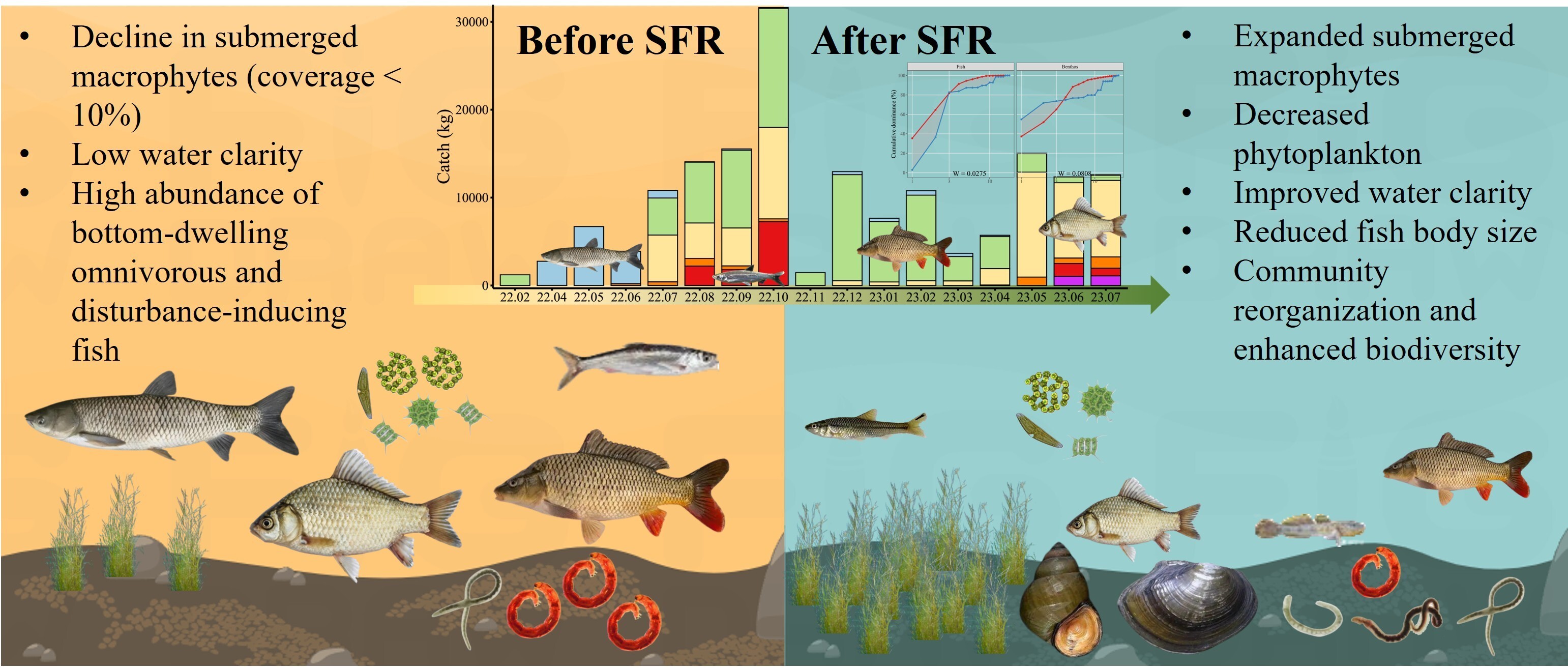
Moderately intensive selective fish removal enhances biodiversity and promotes ecosystem restoration in Lake Caohai. (Image by IHB)
(Editor: MA Yun)