
Newsroom
Study Reveals Cyanobacterial Functional Handoffs and Heterotrophic Subsidies in Biocrusts
Drylands cover approximately 46% of the global terrestrial surface, and over 30% of their exposed soils are naturally armored by biological soil crusts (biocrusts). These delicate micro-ecosystems, founded by filamentous cyanobacteria, stabilize shifting sands, improve soil structure, and drive nutrient cycling, providing indispensable ecosystem functions in arid regions.
Cyanobacterial inoculation has emerged as a promising strategy to accelerate biocrust formation and restore degraded drylands. However, the in situ mechanisms sustaining microbial biomass carbon (MBC) accumulation under seasonal environmental stress remain unclear.
Recently, a research team led by Prof. HU Chunxiang and Associate Prof. LI Hua from the Institute of Hydrobiology (IHB) of the Chinese Academy of Sciences systematically revealed that stage-specific functional handoffs among cyanobacterial guilds and metabolic subsidies from heterotrophic partners, rather than the persistent activity of a single pioneer strain, underpin biocrust carbon accumulation. This study was recently published in ISME Communications.
The researchers conducted an in situ inoculation experiment in the Hobq Desert, Inner Mongolia, inoculating shifting dunes with Konicacronema sp. (formerly Microcoleus sp.) and tracking circannual biocrust development through multi-omics profiling. Although the inoculated strain maintained taxonomic dominance, metatranscriptomic and metaproteomic data revealed a striking functional handoff.
Microcoleus-like populations drove rapid initial formation via the oxidative pentose-phosphate pathway and enzymatic antioxidant systems, whereas Oscillatoria assumed transcriptional dominance during harsher seasonal transitions through enhanced light harvesting, cyclic electron transport, and non-enzymatic photoprotection.
Genome-scale metabolic modeling further predicted that dominant cyanobacteria acted primarily as net importers, receiving amino acids, vitamins, cell-wall precursors, and phosphate from heterotrophic partners while supplying inorganic sulfur and iron–sulfur clusters. These syntrophic partnerships shifted from Microcoleus–Bacteroidetes during formation to Microcoleus–Myxococcota during seasonal transitions.
Piecewise structural equation modeling showed that solar radiation and soil salinity governed MBC indirectly by shaping cyanobacterial composition and the balance between phototrophic assimilation and resource-acquisition strategies.
These findings show that biocrust carbon accumulation is sustained by temporal functional division among cyanobacterial guilds and heterotrophic subsidies, not by a single pioneer strain. This provides a trait-based roadmap for designing resilient synthetic inocula for dryland restoration that combine Microcoleus-like pioneers, stress-tolerant Oscillatoria and Crinalium, and heterotrophic partners.
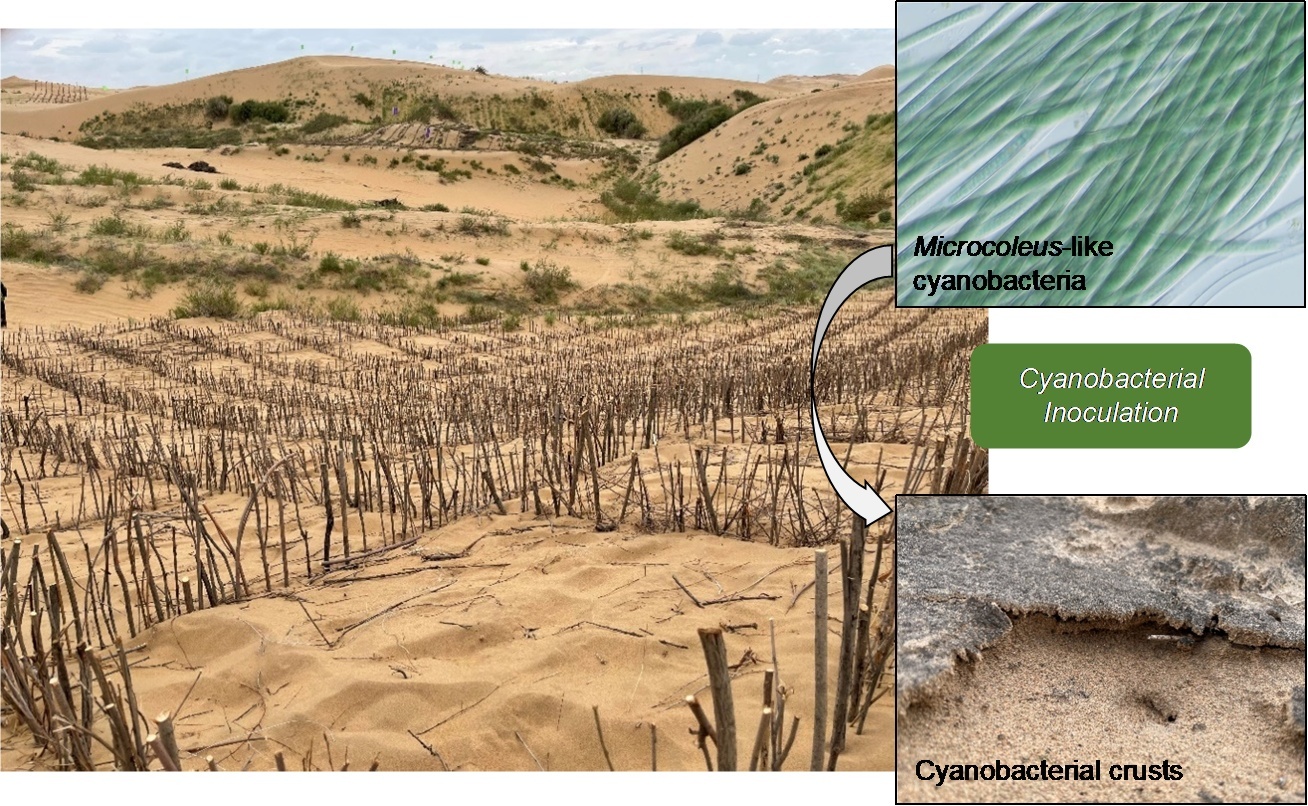
Field view of the study site, microscope photo of cyanobacterial inoculum, and close-up view of the biocrust layer. (Image by IHB)
(Editor: MA Yun)