Centers
Research Group on Microalgal Carbon Fixation
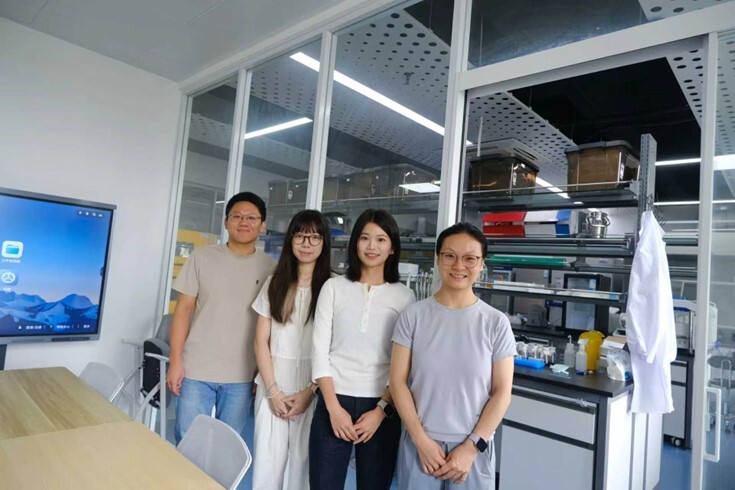
PI: Prof. Kun Zang, PhD
Group Members: Dr. Xiaomei Xu
PhD students: Yongyin Liu
Postgraduate students: Yaoju Fan, Xiangyu Wen
Intern: Qi Ye
Research Interests of Our Group
Photosynthesis is the most fundamental biochemical process on Earth, using solar energy to convert CO₂ and water into carbohydrates and release oxygen. Plants, cyanobacteria, and eukaryotic algae collectively fix hundreds of billions of tons of CO₂ annually through photosynthesis. The enzyme responsible for CO₂ fixation is ribulose-1,5-bisphosphate carboxylase/oxygenase (Rubisco). However, Rubisco has low carboxylation efficiency and catalyzes a side reaction with O₂, triggering photorespiration, which consumes energy and releases fixed CO₂. Rubisco is therefore a key factor limiting photosynthetic efficiency. Unlike plants, cyanobacteria and eukaryotic algae have evolved a highly efficient photosynthetic carbon-fixation system—the CO₂ concentrating mechanism (CCM).
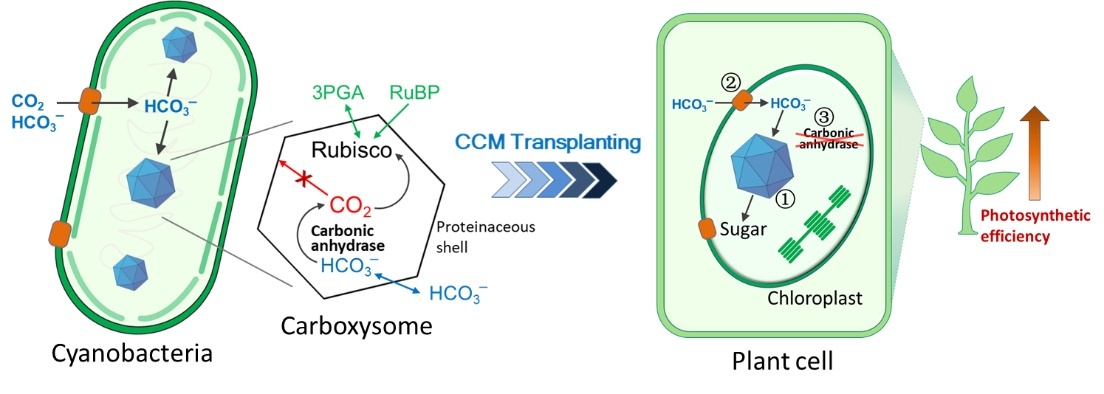
The cyanobacterial CCM consists of inorganic carbon (CO₂/HCO₃⁻) transporters on the cell membrane and carboxysomes. The carboxysome, the core carbon-fixing organelle, uses a selectively permeable protein shell to encapsulate Rubisco and carbonic anhydrase. O₂ and CO₂ cannot pass through the protein shell, while HCO₃⁻ enriched in the cytoplasm by inorganic carbon transporters can enter the carboxysome and is converted into CO₂ by carbonic anhydrase. The CO₂ cannot escape and is thus highly enriched, significantly enhancing the carbon-fixation efficiency of Rubisco.
Our group currently focuses on the assembly mechanisms and engineering applications of cyanobacterial carboxysomes:
1. Elucidating the mechanisms of liquid–liquid phase separation (LLPS)-mediated carboxysome assembly, and exploring functional reconstitution in plant chloroplasts to transplant the complete cyanobacterial CCM into higher plants, thereby improving photosynthetic carbon-fixation efficiency.
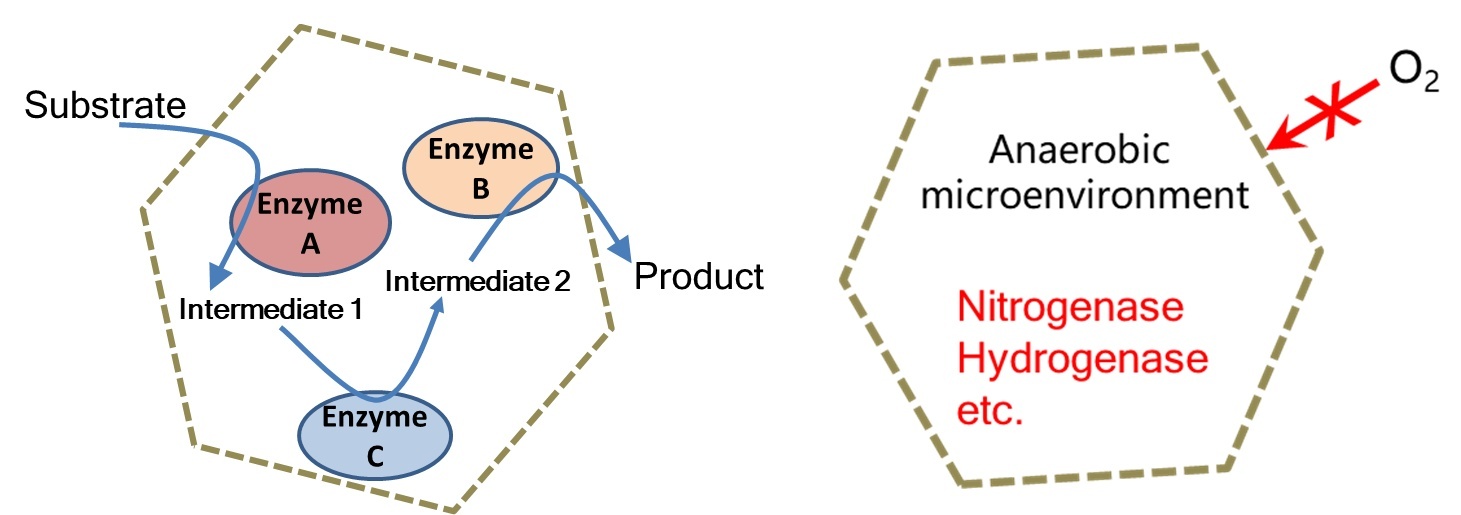
2. Engineering carboxysome-like protein-based organelles for enclosing multi-enzyme cascade pathways, or for encapsulating and protecting oxygen-sensitive reactions (e.g., nitrogenase, hydrogenase), to improve metabolic reaction efficiency and eventually construct artificial protein-based organelles with custom-designed functions.
Job openings
Our group was established in July 2026 and is currently recruiting Associate Researchers, Postdoctors, PhD students and Research Assistants. We welcome young talents to join us!
Contact: zangkun@ihb.ac.cn
Recent publications:
1. Zang K†, Hong X†, .., Hayer-Hartl M. Stages of biomolecular condensate formation in pro-β-carboxysome assembly. Nature Plants. 2026 Feb 12, 447–464.
2. Zang K†, Wang H†, Hartl FU, Hayer-Hartl M. Scaffolding protein CcmM directs multiprotein phase separation in b-carboxysome biogenesis. Nature Structural & Molecular Biology. 2021 Nov;28(11):909-922.
3. Zang K, Li F, Ma Q. The dUTPase of white spot syndrome virus assembles its active sites in a noncanonical manner. Journal of Biological Chemistry. 2018 Jan;293 (3):1088-1099.
4. Liu C†, Zang K†, Ma Q. Structural insight into ligand interactions of thymidylate synthase from white spot syndrome virus. Biochemical and Biophysical Research Communications. 2025 May; 20:759:151683.
5. Liu C†, Zang K†, ..,Ma Q. Structural analysis of a shrimp thymidylate synthase reveals species-specific interactions with dUMP and raltitrexed. Journal of Oceanology and Limnology. 2020 Nov;38(6):1891-1899.
6. Xu Y†, Zang K†,.., Shi X. Insulin-like growth factors I and II in starry flounder (Platichthys stellatus): molecular cloning and differential expression during embryonic development. Fish Physiology and Biochemistry. 2015 Feb;41(1):139-152.
7. Gionfriddo M, Zang K, Hayer-Hartl M. The challenge of engineering Rubisco for improving photosynthesis. FEBS letters. 2023 Jun;597(13):1678-1680.
† Equal contribution