Research
Dianchi Lake Ecosystem Observation and Research Station, Institute of Hydrobiology, Chinese Academy of Sciences
The Dianchi Lake Ecosystem Observation and Research Station, Institute of Hydrobiology, Chinese Academy of Sciences (hereinafter referred to as the Dianchi Station), focuses its monitoring area mainly on Dianchi Lake and extends across the Dianchi Lake Basin. Dianchi Lake is located in a key ecologically sensitive area of the upper reaches of the Yangtze River and forms an important part of the ecological security barrier of southwestern China, making its ecological protection status extremely important.
The station aims to conduct long-term observation and systematic research on changes in the physical, chemical, biological, and other ecosystem elements of Dianchi Lake and its basin. Through this work, it seeks to deepen understanding of the limnological phenomena and patterns unique to plateau lakes, and to gradually explain the evolutionary patterns of Dianchi Lake and other plateau lake ecosystems and the mechanisms of regime shifts in plateau lakes. It also aims to elucidate the evolutionary patterns of the eutrophication process in the Dianchi water environment and the corresponding control strategies.
On the basis of this fundamental research, the station carries out applied research, including technologies for controlling cyanobacterial bloom pollution in Dianchi Lake, ecological engineering restoration technologies for the water environment, and experimental demonstration areas for ecosystem reconstruction. This research provides a scientific basis for health assessment of plateau lake ecosystems and for the establishment of sustainable regulation mechanisms and optimized management technologies.
Since the establishment of the station, the team from the Institute of Hydrobiology has served as chief scientists or lead institutions in collaboration with more than 30 research institutes and universities across China, engaging nearly 500 scientific and technical personnel from its own and partner institutions. This work has continued for nearly 30 years. The team has undertaken and successfully completed a series of research projects on pollution control and ecological environmental protection of Dianchi Lake, covering the full chain from basic theory to technology development, engineering demonstration, and management strategy.
Guided by the concept of systematic and comprehensive governance, the team has carried out applied research on technology development and engineering demonstration across the entire Dianchi Lake Basin. This includes cyanobacterial bloom control, reduction of pollution loads from black-odorous inflow rivers, ecological restoration of heavily polluted lake bays, comprehensive governance of river–lake composite systems, and restoration of the Dianchi Lake ecosystem. The results of these scientific research and technological development efforts have played a positive role in the protection and governance of Dianchi Lake.
In 2000, to meet the needs of the National Major Science and Technology Project "Cyanobacterial Bloom Pollution Control Technology for Dianchi Lake" (2000–2004), the Institute of Hydrobiology, Chinese Academy of Sciences, established the "Dianchi Ecosystem Field Work Station of the Institute of Hydrobiology, Chinese Academy of Sciences" in Xiaohezui Village, Liujia Township, Guandu District, Kunming City. The field station was relocated in 2013 to No. 461, Fushan Village, Biji Town, Xishan District, Kunming City (24°54.243′N; 102°38.755′E). Over more than two decades, although the station site has been relocated several times, the research team's work in serving the protection and governance of Dianchi Lake has continued to the present day.
In 2022, the station jointly applied with local institutions, including the Kunming Dianchi Plateau Lake Research Institute, for the "Yunnan Provincial Field Scientific Observation and Research Station for the Dianchi Lake Ecosystem." In 2025, the station passed acceptance evaluation by the Yunnan Provincial Department of Science and Technology and was rated "Excellent."
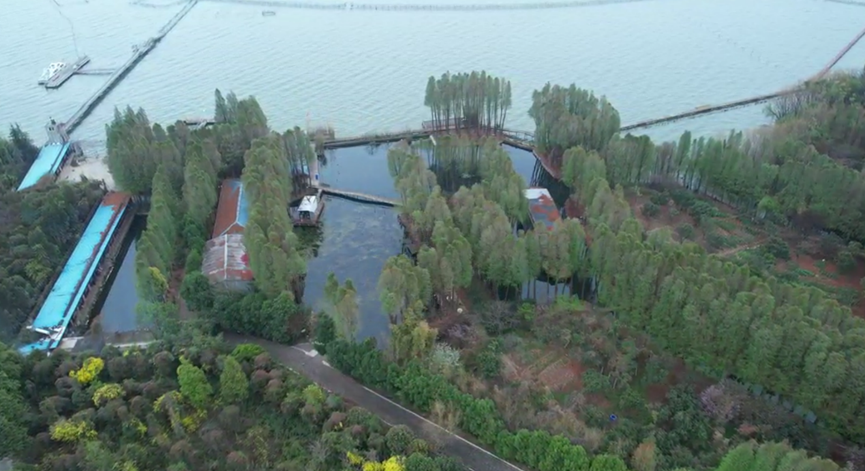
The Dianchi Station has nearly 450 m² of laboratory and office space, including 110 m² of laboratory area and 3,000 m² of research and experimental grounds. In recent years, supported by research projects such as the 863 Program, the 973 Program, and the National Water Pollution Control and Treatment Science and Technology Major Project, the station has established a well-equipped field experimental platform, a multi-parameter automatic monitoring system for aquatic ecology, sampling and survey speedboats, and algae-control vessels.
At present, more than 20 senior researchers and over 20 doctoral students, master's students, and postdoctoral researchers from the Institute of Hydrobiology, Chinese Academy of Sciences, are conducting research at the Dianchi Lake Ecosystem Observation and Research Station, Institute of Hydrobiology, Chinese Academy of Sciences.
Head: WU Xingqiang