Highlights
Microbial Maestros in the Gonads: How Bacteria Communities Influence Natural Sex Reversal in Fish
Did you know that the organs responsible for reproduction, the ovaries and testes, host their own unique communities of microbes? Just like the gut or skin, the gonads contain bacteria that may play crucial roles in function. In a new study, scientists have turned to an extraordinary fish, the hermaphroditic swamp eel, to uncover how these gonadal microbes change during natural sex reversal (NSR) and what they do.
In a study published in Microbiome, a research team led by Prof. LUO Daji from the Institute of Hydrobiology (IHB) of the Chinese Academy of Sciences revealed that the swamp eel’s gonads contain microbial communities as rich as those found in the gut, skin, and blood, and more than half of these gonadal bacteria originate from the gut and bloodstream, suggesting an intriguing internal migration of microbes.
The swamp eel (Monopterus albus) is a remarkable animal. It begins life as a female and later transforms into a male. This natural sex reversal offers a rare window into how gonad-associated bacteria respond to, and possibly influence, reproductive biology.
By comparing ovarian and testicular microbiomes, the team identified ovarian and testicular dominant bacteria. In ovaries, a bacterium called Bacillus dominated. To test its role, the researchers injected Bacillus into the fish and observed striking changes. The ovarian microbial balance was disrupted, and metabolic activity shifted, particularly in processes related to amino acid and lipid metabolism. These shifts could be vital for maintaining normal ovarian function.
In males, the same Bacillus triggered a different response. It stimulated inflammation in the testes and led to reduced sperm motility. This suggests that the same microbe can have distinct, sex-dependent effects.
“Our findings show that gonadal microbiomes are not just passive residents” explained first author Dr. MENG Kaifeng. “They interact with host physiology in ways that may be essential for reproduction and even for facilitating natural sex reversal processes.”
The study opens a new frontier in reproductive biology and microbiology. If bacteria in gonads can influence metabolism and immune responses, they might affect fertility, development, and health across species, including possibly humans. Beyond understanding nature’s wonders, this study could inspire applications in aquaculture, where strategically managing microbial communities could enhance breeding efficiency and reproductive health. This approach may even offer novel, non-hormonal strategies for influencing sexual development in farmed fish. Ultimately, it underscores that microbes are intimate partners in animal biology, hidden in places we once thought sterile.
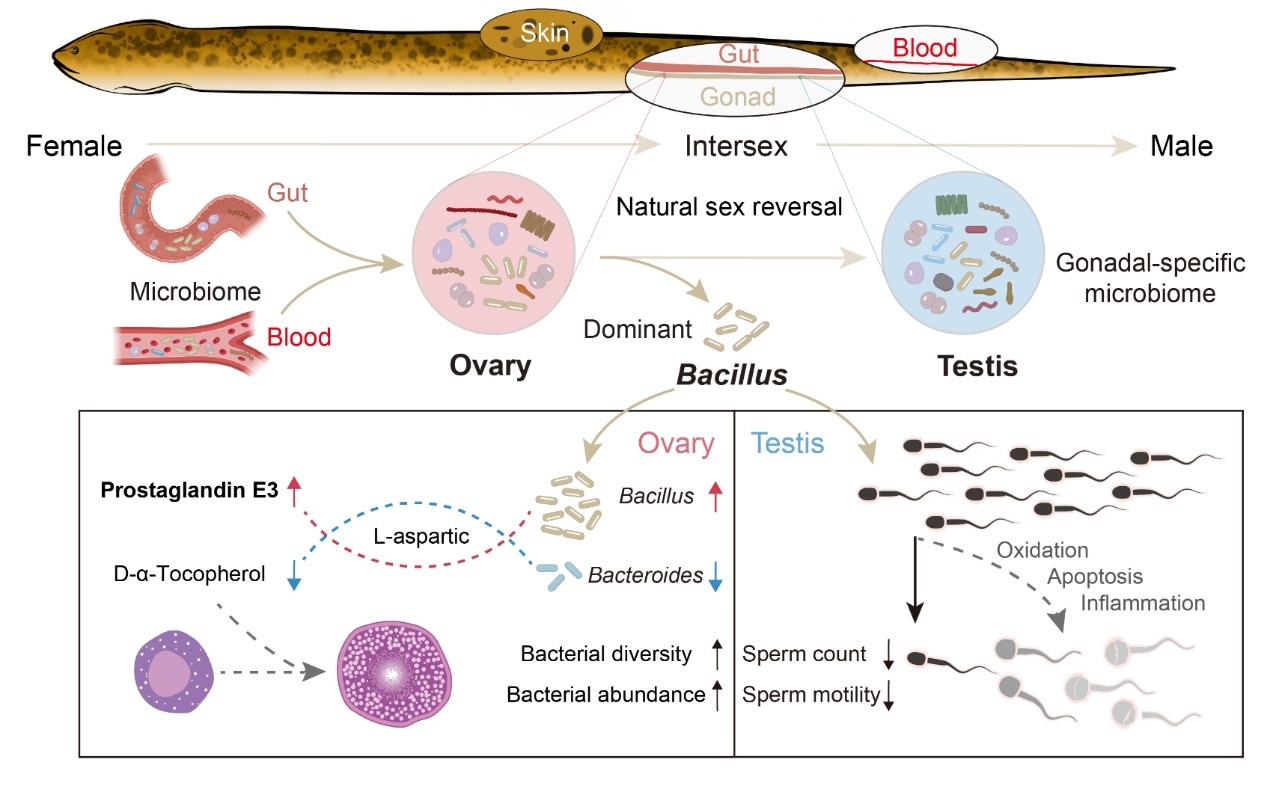
The bidirectional regulatory function of the dominant ovarian bacteria Bacillus in both the ovary and testis of the swamp eel (Monopterus albus) (Image by IHB)
Video from Microbiome & This Study was contributed by IHB
(Editor: MA Yun)