Highlights
A New Unified Model Reveals Unimodal Relationship between Productivity-species Richness in Fish Communities
Ecologists have long sought to understand how changes in ecosystem productivity shape biodiversity. Prior studies have shown that productivity and species richness may be positively related, negatively related, or hump-shaped, with richness peaking at intermediate productivity. Yet this pattern has been confirmed mainly in plant communities. In animal communities, especially complex fish assemblages, interacting ecological processes and the difficulty of obtaining quantitative data have left clear empirical evidence scarce, and the mechanism remains unresolved within a unified theoretical framework.
Recently, an international research collaborative team led by Prof. WANG Qidong from the Institute of Hydrobiology (HB) of the Chinese Academy of Sciences proposed a new unified model to reveal the unimodal relationship between productivity and species richness in fish communities. This study was published in Ecology Letters.
Using systematic field surveys, the researchers collected first-hand quantitative data from 39 shallow lakes in the middle and lower Yangtze River basin and provided the first clear evidence of a stable hump-shaped productivity–species richness relationship in fish communities. Diversity increases and then declines as productivity rises, demonstrating that biodiversity cannot increase indefinitely with greater energy input. These findings offer key evidence for understanding fish community shifts under eutrophication.
The researchers proposed a new unified model (the JBE model) that integrates three core hypotheses: the More Individuals Hypothesis (J), the Biomass-Driven Competition Hypothesis (B), and the Environmental Filter Hypothesis (E). By linking observed patterns with ecological theory and statistical modeling in a rigorous and concise framework, the model reconstructs the unimodal relationship observed in lake fish communities and offers a quantifiable, testable mechanistic explanation for the long-standing productivity–diversity puzzle.
Importantly, the study provides rare evidence for intensified species interactions along a productivity gradient in animal communities. Competition-driven losses occur before diversity declines caused by environmental stress (e.g., hypoxia) and offset any richness gains from higher abundance, suggesting that biodiversity decline may serve as an early warning of ecosystem degradation.
This study strengthens understanding of structural stability in lake ecosystems and inform conservation, restoration, and management under China’s ten-year fishing ban. It emphasizes that management should prioritize the dynamic balance and trade-offs between productivity and diversity, rather than focusing only on fish yield or species counts. A promising application of the JBE framework will be to assess how the 10-year fishing ban in the Yangtze River shapes fish productivity and richness patterns in lakes.
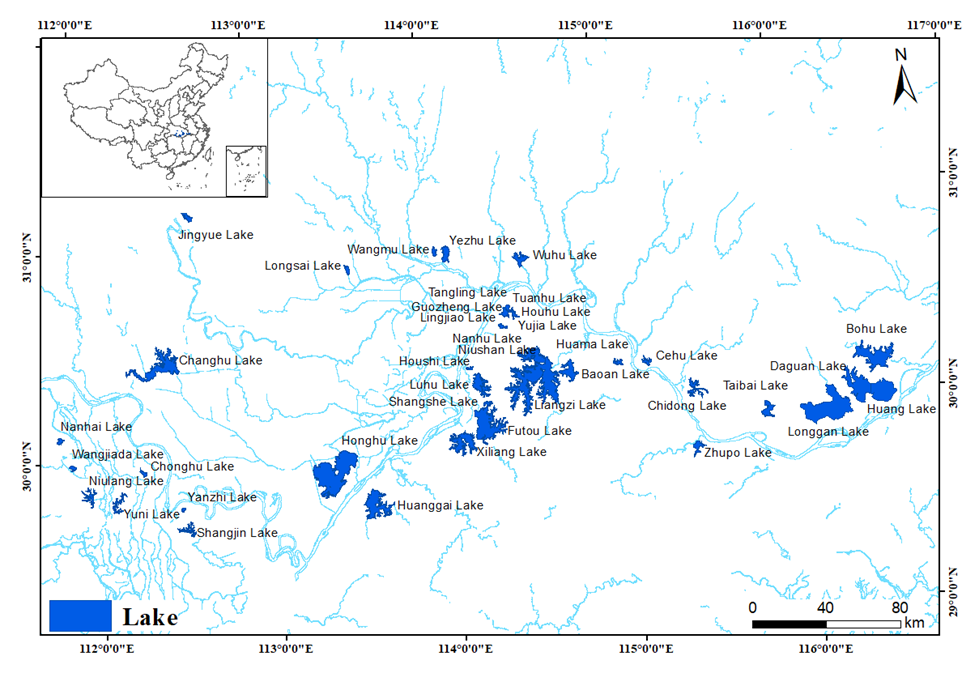
Map of the study region, the middle Yangtze River, in China and the locations of surveyed lakes (Image by IHB)
(Editor: MA Yun)