Highlights
Yangtze River Fishing Ban Halts Seven Decades of Biodiversity Decline
The Yangtze River Basin, a global biodiversity hotspot, has endured severe ecological degradation over the past seven decades due to intense human activities, leading to marked declines in aquatic biodiversity. In 2021, China responded by launching a comprehensive ten-year fishing ban across the basin, one of the most extensive and strict inland fishery conservation measures worldwide. While this represents a significant restoration effort, its ecological outcomes remained unknown, calling for a comprehensive scientific assessment.
In a landmark study published in the journal Science, researchers led by Prof. CHEN Yushun from the Institute of Hydrobiology (IHB) of the Chinese Academy of Sciences, together with domestic and international collaborators, revealed that this ban has not only halted the 70-year decline in Yangtze fish resources but also triggered an initial recovery.
Based on systematic long-term monitoring data from 2018 to 2023, researchers comprehensively analyzed the dynamics of fish communities in the Yangtze’s mainstream before and after the full fishing ban. The analysis encompassed multiple dimensions, including fish species richness, biomass, abundance, evenness, and beta diversity. Furthermore, the study quantified the impact mechanisms of multiple stressors, such as water quality, hydrology, climate change, land use, shoreline development, shipping, and fishing pressure, on fish diversity.
The findings indicate significant improvements in key indicators, including fish biomass, body condition, species diversity, and initial recovery of threatened species. Notably, larger-bodied species benefited greatly from the fishing ban, showing significant increases in biomass. Further evidence is provided by an increase in the fish condition factor for both larger- and smaller-bodied species.
Some species, such as the slender tongue sole (Cynoglossus gracilis), were observed their populations increase after the ban, with their freshwater migration extending further upstream. Endangered fish species such as the Yangtze sturgeon (Acipenser dabryanus), Chinese sucker (Myxocyprinus asiaticus), and tube fish (Ochetobius elongatus), although still rare, also showed signs of initial recovery.
Another notable positive outcome of the fishing ban was the short-term recovery trajectory of the only extant freshwater mammal in the Yangtze River, the Yangtze finless porpoise (Neophocaena asiaeorientalis asiaeorientalis), whose population increased by one-third from 445 in 2017 to 595 in 2022. However, the population status of the Chinese sturgeon (Acipenser sinensis) still faces an uncertain future.
By analyzing the links between conservation measures and biodiversity relationships through Generalized Least-Squares (GLS)-based Structural Equation Models (SEM), the study revealed that the fishing ban is the primary driver of the initial recovery trajectory of the Yangtze ecosystem. Other factors, such as reduced vessel traffic, the creation of riparian vegetation buffers, and improved water quality, have also contributed to biological recovery.
The comprehensive fishing ban implemented under the Yangtze River Protection Law has effectively halted seven decades of biodiversity decline. While short-term monitoring data show promising signs, the long-term sustainability of this recovery requires further verification. It is crucial to recognize that these gains could be reversed if commercial fishing resumes or if stressors such as habitat fragmentation and water quality deterioration persist.
The ten-year fishing ban serves as a key model for global river restoration, demonstrating the feasibility of large-scale conservation actions in achieving the goals of the UN Decade on Ecosystem Restoration. Moving forward, efforts must focus on consolidating the achievements of the fishing ban, systematically addressing multiple stressors, and promoting synergistic progress between ecological conservation and sustainable development.
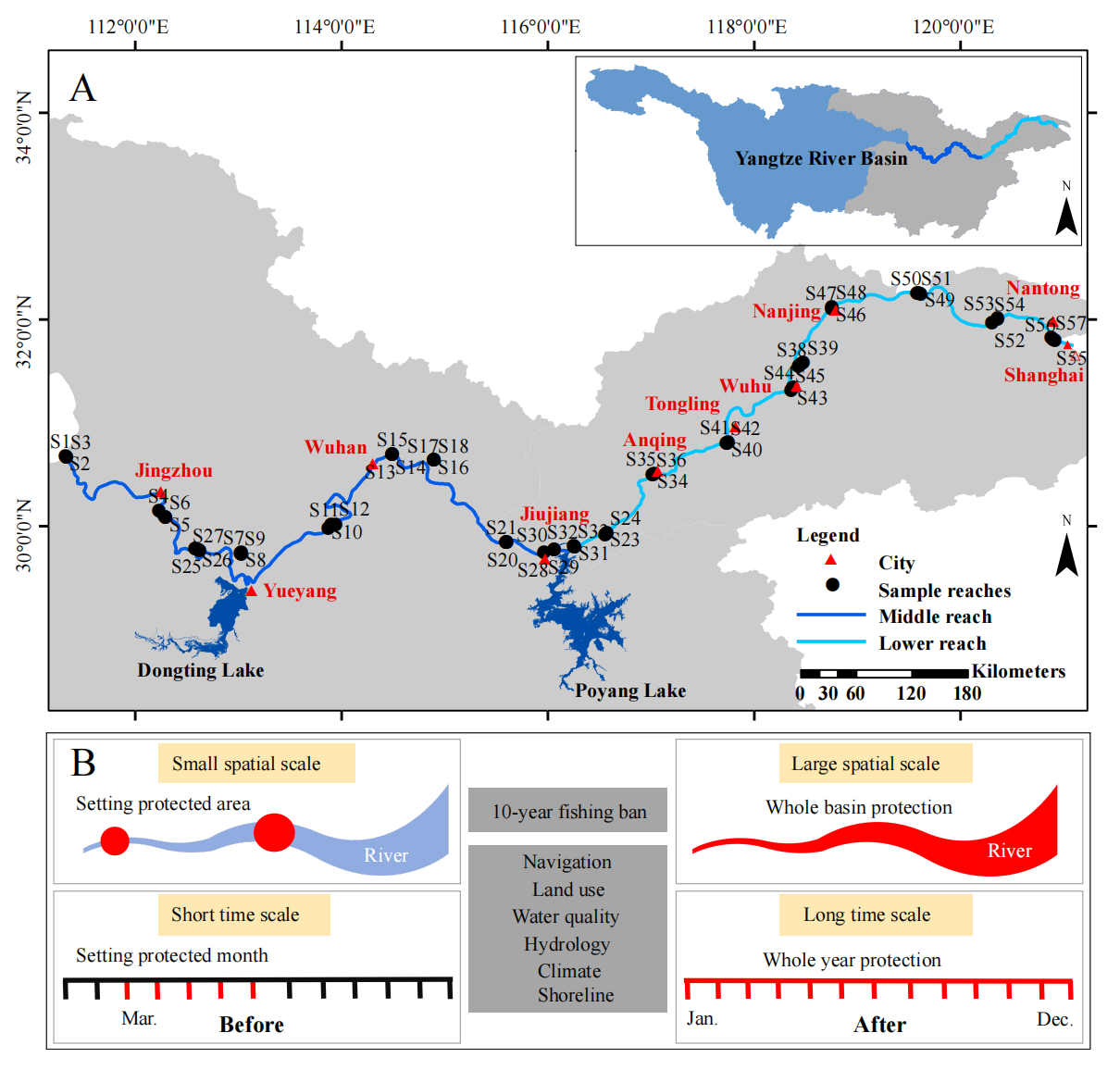
(A) map of the middle and lower Yangtze River and sampling reaches during 2018–2023. (B) spatial and temporal changes in fish ban policies in the Yangtze River Basin. (Image by IHB)
(Editor: MA Yun)
Follow us on Facebook