Highlights
Bacterial-algal Interactions Shape Diatom Adaptation to Carbon Changes
Diatoms, one of the most abundant and diverse groups within the phytoplankton community, constitute crucial primary producers in marine ecosystems and account for approximately 20% of global primary productivity. In surface seawater, despite the high concentration of dissolved inorganic carbon, photosynthesis by phytoplankton leads to the rapid depletion of inorganic carbon, thereby limiting the growth of diatoms.
In addition to the inorganic carbon concentrating mechanisms (CCMs) possessed by almost all marine diatoms, mixotrophic growth (simultaneous utilization of inorganic and organic carbon) driven by algae-bacteria interactions is also of great significance for establishing the dominance of marine diatom groups. However, the mechanisms underlying diatom-bacteria interactions under mixotrophic conditions have not been fully elucidated, which limits the in-depth understanding of diatom ecological adaptation and the regulatory mechanisms of the marine carbon cycle, and has become a key challenge in related research fields.
Addressing this issue, the research team led by Prof. HU Hanhua from the Institute of Hydrobiology (IHB) of the Chinese Academy of Sciences, revealed a syntrophic relationship between the model obligate photoautotroph diatom Phaeodactylum tricornutum and the rod-shaped bacterium Loktanella vestfoldensis, and its important role in the carbon adaptation mechanism of diatoms. The study was published in the journal Nature Communications.
In this study, the researchers conducted co-culture experiments, transcriptomics and metabolomics analyses, and performed co-occurrence analysis based on Tara oceans biodiversity data. They found that growth of the diatom depends on the support of L. vestfoldensis for the supply of necessary carbon source when glucose serves as the sole carbon source (GC), while L. vestfoldensis shows dependence on P. tricornutum when CO2 is the sole carbon source (AC). Growth changes and metabolite analysis results of algae and bacteria under co-culture indicate that mixed carbon source (MC) induces competitive dynamics. P. tricornutum preferentially utilizes inorganic carbon while partially suppressing L. vestfoldensis via antimicrobial secretion (e.g., p-anisic acid and isonicotinic acid).
Further reanalysis of Tara Oceans metagenomic data showed frequent co-occurrence of Loktanella with diatoms including Chaetoceros and Thalassiosira, indicating the ecological relevance of this partnership. Co-culture with L. vestfoldensis supports robust growth of Chaetoceros muelleri and Thalassiosira pseudonana in the presence of glucose as the sole carbon source.
Transcriptomic and metabolomic analyses revealed that P. tricornutum maintains a photoautotrophic metabolism in co-culture, as indicated by the up-regulation of genes involved in inorganic carbon concentration and photosynthesis, while the co-cultured bacterium likely supplies CO2 and growth-stimulating metabolites such as indole-3-acetic acid.
This study demonstrate that bacterial-algal interactions may shape diatom adaptation to carbon changes and contribute to marine carbon cycling. It lays the foundation for constructing a universal model of marine diatom-bacteria interaction under carbon source changes.
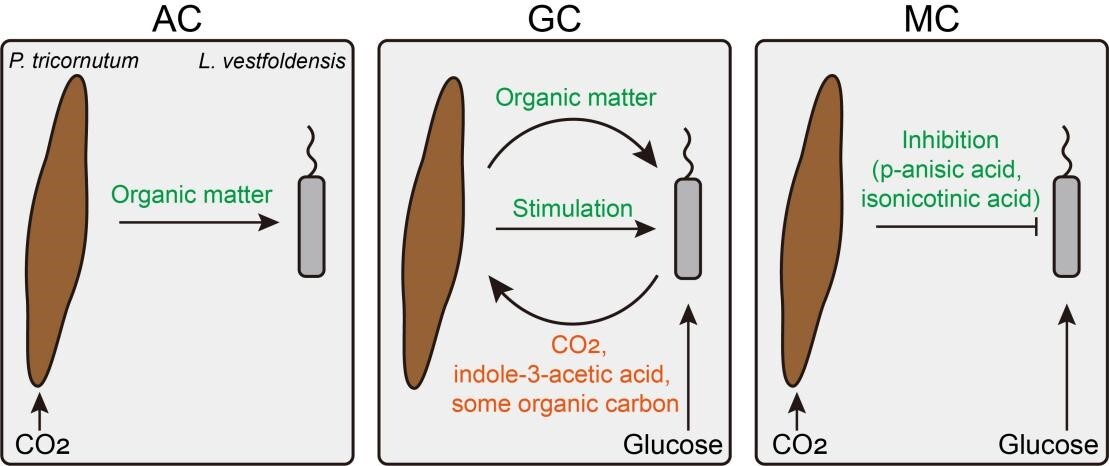
Models of P. tricornutum and L. vestfoldensis interactions under different carbon sources. (Image by IHB)
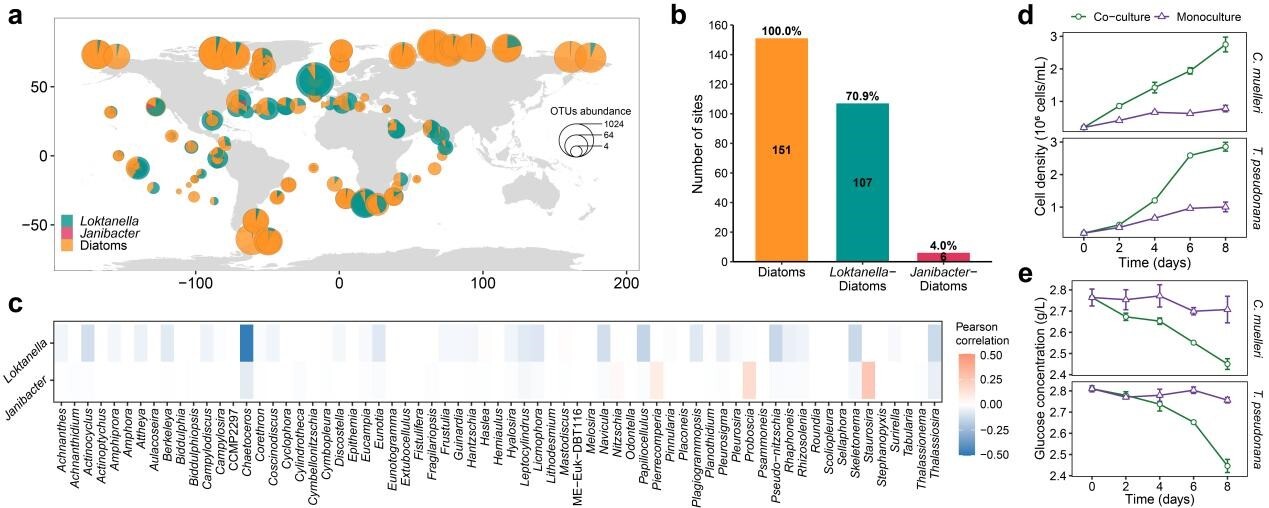
Co-occurrence of L. vestfoldensis and diatoms in global oceans and experimental verification in the ubiquitous diatoms. (Image by IHB)
(Editor: MA Yun)
Follow us on Facebook