Highlights
Genomic Analyses Reveal Dynamic Body Size Evolution During Speciation of Lake Malawi Cichlids
Species divergence and speciation are central questions in evolutionary biology and biodiversity research. Understanding how populations diverge under the combined effects of ecological selection and genetic variation is essential for explaining adaptive radiation, ecological differentiation, and patterns of genomic evolution.
Fish, with their remarkable ecological diversity, morphological plasticity, and variable evolutionary rates, provide excellent systems for studying the mechanisms of speciation. Among them, the rapid diversification of fishes inhabiting plateau regions under strong environmental gradients and geographic isolation, as well as the extensive adaptive radiation of cichlid fishes in the three major African lakes over relatively short evolutionary timescales, are widely recognized as classic models for studying species diversification and rapid speciation.
Recently, a collaborative study led by Prof. HE Shunping’s team from the Institute of Hydrobiology (IHB) of the Chinese Academy of Sciences, in collaboration with Prof. Martin J. Genner from the University of Bristol, UK, uncovered novel genomic mechanisms underlying body size evolution and rapid speciation of cichlid fishes in Lake Malawi. This work was published in Genome Research.
In this study, the researchers focused on the predatory cichlid fishes of the genus Rhamphochromis inhabiting the open waters of Lake Malawi. Using whole-genome sequencing data, the study systematically analyzed the patterns of body size divergence during the rapid radiation of this group and explored their genomic basis.
Genomic analyses revealed that major body size differences in Rhamphochromis species evolved independently multiple times during their evolutionary history and were accompanied by clear signals of ancient interspecific hybridization.
Genome-wide association analysis further identified a series of genetic variations significantly associated with body size. These variations were mainly enriched in genes related to vertebrate skeletal development and nervous system function, indicating that body size evolution is not a change of a single trait, but is closely coupled with morphological development and behavioral regulation networks.
The study further focused on Lake Kingiri, a volcanic crater lake within the Lake Malawi catchment with a diameter of only about 600 meters. Although geographically isolated from Lake Malawi, the lake remains hydrologically connected and provides an ideal system for studying sympatric speciation. The researchers identified two sympatric and ecomorphologically divergent Rhamphochromis species inhabiting Lake Kingiri (one small-bodied and the other large-bodied). Population genomic analyses showed that the two species shared a single common ancestor and diverged less than 2,000 years ago.
Further analyses indicated that the large-bodied species experienced strong directional selection over this extremely short evolutionary timescale. Signatures of selection were predominantly enriched in genetic variants associated with anatomical development and nervous system function. These findings suggest that body size-related traits may play an important role in sympatric ecological divergence and speciation.
Overall, the genomic evidence from this study provides strong evidence for a role of body size divergence in ecological speciation in Lake Malawi cichlids. The findings further indicate that body size-associated genetic variants have served as key targets of natural selection during the large-scale adaptive radiation of Lake Malawi cichlids. This work also provides new insights into the mechanisms underlying rapid adaptive radiation and species diversification in cichlid fishes.
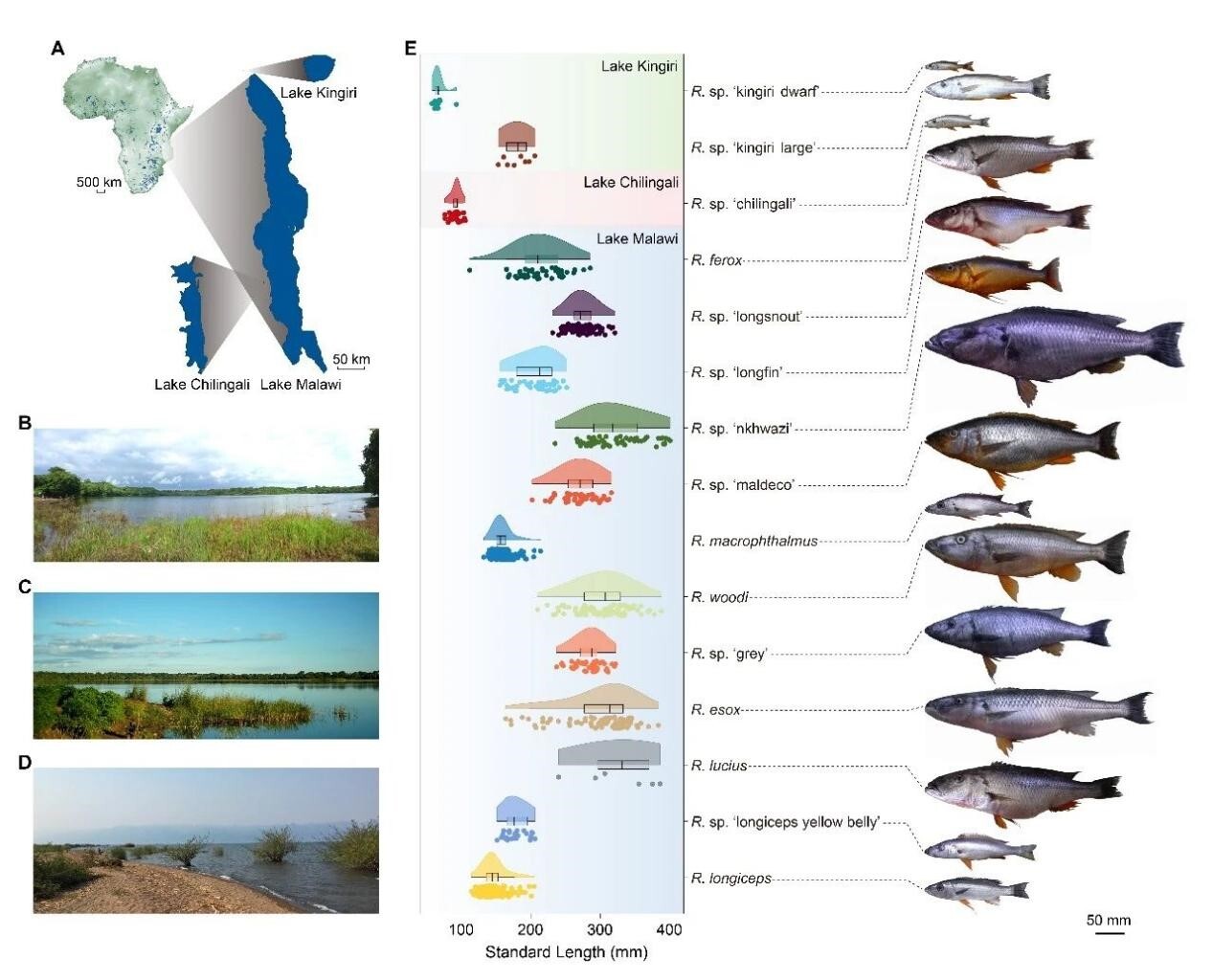
Sampling sites and body size variation in Rhamphochromis cichlid fish species (Image by IHB)
(Editor: MA Yun)