Highlights
Rumen Ciliates Modulate Methane Emissions in Ruminants
Methane (CH4) is a potent greenhouse gas and a major contributor to global warming. The increase in global methane emissions is primarily driven by human activities, such as animal husbandry, rice cultivation, and the production and utilization of fossil fuels. Among these, methane emitted by ruminants like cattle and sheep accounts for over 30% of global anthropogenic methane emissions.
Methane in ruminants is mainly produced through anaerobic fermentation by rumen microorganisms, among which protozoan ciliates can constitute up to 50% of the total rumen microbial biomass. Rumen ciliates have long been recognized as important contributors to methane emissions in ruminants, but the mechanisms underlying their role remain poorly understood.
Recently, a collaborative study led by Prof. MIAO Wei from the Institute of Hydrobiology (IHB) of the Chinese Academy of Sciences, in partnership with Nanjing Agricultural University, Jianghan University, Jilin Agricultural University, and Northwestern Polytechnical University, has uncovered the mechanisms by which rumen ciliates modulate methane emissions in ruminants. This study was published in Science.
Focusing on rumen ciliates, which are an abundant yet understudied component of the rumen microbiome, the researchers, as part of the Protist 10,000 Genomes Project (P10K), constructed the world's largest genomic dataset for these organisms. This resource comprises 450 genomes spanning six families and 18 genera.
Based on morphological and functional characteristics, rumen ciliates can be broadly divided into two groups: Vestibuliferida, whose cells are entirely covered with cilia, and Entodiniomorphida, in which cilia are restricted to the oral region. The researchers also successfully established anaerobic cultivation systems for three representative species, providing a foundation for future functional studies.
A key discovery of this study is a previously unknown single-membrane hydrogen-producing organelle, termed the “hydrogenobody”. Structurally distinct from the double-membraned hydrogenosome found in other protists, the hydrogenobody contains specific hydrogenases and oxygen reductases, enabling it to simultaneously produce hydrogen and scavenge oxygen.
By supplying hydrogen, which is the primary substrate for methanogens, and maintaining an anaerobic environment, this organelle plays a central role in rumen methanogenesis and represents a promising target for methane mitigation strategies.
Leveraging the newly established genomic catalog, the researchers further analyzed nearly 2,000 rumen meta-omics datasets. The results revealed strong associations among rumen ciliates, methanogens, and methane emission levels.
Importantly, hydrogenobodies were found to be predominantly localized in cilia-rich regions. Their abundance is tens of times higher in Vestibuliferida than in Entodiniomorphida, corresponding to a greater contribution to methane production. These findings identify Vestibuliferida ciliates as a key target group for interventions aimed at reducing ruminant methane emissions.
Overall, this study challenges existing paradigms and provides novel insights into rumen ciliate–modulated methanogenesis, centered on a “hydrogenobody-mediated coupling of hydrogen production and oxygen scavenging,” and provides a theoretical basis for developing new strategies to mitigate methane emissions.
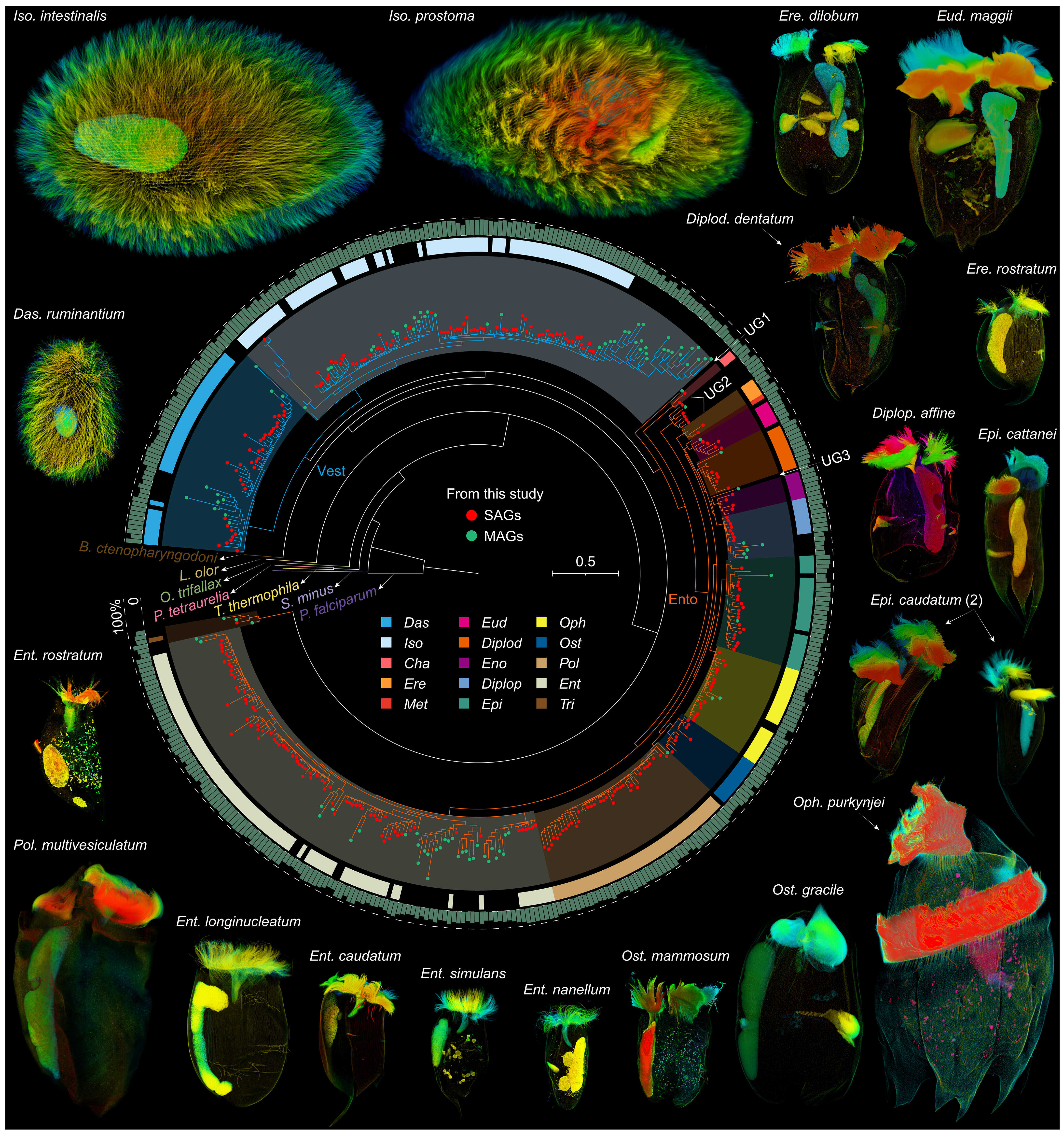
Rumen ciliate genome catalogue (Image by IHB)
A novel hydrogen-producing organelle in rumen ciliates - Hydrogenobody (Image by IHB)
(Editor: MA Yun)