Highlights
Study Reveals Novel Role of Primary Cilia in Gingival Aging
Gingival aging contributes substantially to periodontal tissue degeneration in older adults, yet the underlying molecular mechanisms remain largely unknown. In particular, whether primary cilia participate in the regulation of gingival fibroblast senescence has long remained elusive.
Recently, a research team led by Prof. HUANG Kaiyao from the Institute of Hydrobiology (IHB) of the Chinese Academy of Sciences, in collaboration with researchers from the School and Hospital of Stomatology, Wuhan University, have uncovered a previously unrecognized role of primary cilia in gingival aging. Their findings were published in Aging Cell.
The researchers first established the first single-cell transcriptomic atlas of human gingival aging and found that gingival fibroblasts exhibited the most pronounced senescence signatures among all major cell populations. At the same time, genes associated with ciliogenesis were significantly upregulated. Further analyses of human gingival tissues and primary fibroblasts confirmed that aged cells possessed more numerous and longer primary cilia, accompanied by increased DNA damage and enhanced cellular senescence.
To investigate the functional significance of these changes, the researchers inhibited ciliogenesis using two independent genetic approaches targeting IFT88 and KIF3A, together with pharmacological inhibition by Ciliobrevin D. All three strategies consistently alleviated senescence-associated phenotypes, reduced DNA damage, suppressed inflammatory responses, and restored cellular proliferative capacity.
Mechanistically, the researchers demonstrated that suppression of ciliogenesis activated AKT signaling, promoted Forkhead box01 (FOXO1) phosphorylation, and enhanced the expression of DNA repair-related genes. Blocking AKT signaling partially abolished these protective effects, revealing a previously unrecognized primary cilia–AKT–FOXO1 signaling axis that regulates gingival fibroblast senescence.
The researchers further validated these findings in aged mice by locally suppressing ciliogenesis in gingival tissues using an adeno-associated virus (AAV)-based strategy. This intervention significantly reduced gingival cellular senescence, alleviated inflammation and fibrosis, and improved periodontal tissue integrity, highlighting the therapeutic potential of targeting ciliary dynamics in vivo.
This work provides the first evidence that primary cilia function as key regulators of gingival fibroblast senescence and identifies ciliary dynamics together with downstream AKT signaling as promising therapeutic targets for age-related periodontal diseases. The findings offer new insights into the molecular basis of tissue aging and provide a potential strategy for precision intervention against oral aging.
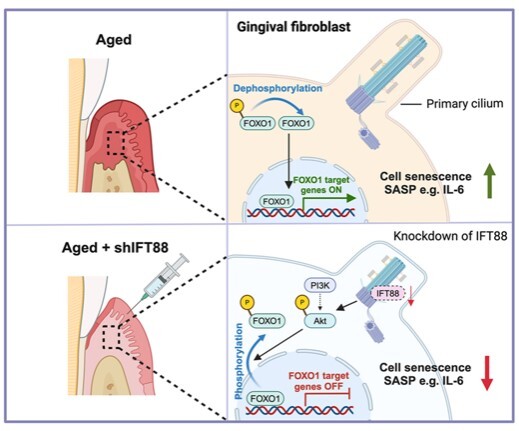
Proposed mechanism by which primary cilia regulate gingival fibroblast senescence through the AKT–FOXO1 signaling during gingival aging. (Image by IHB)
(Editor: MA Yun)