Highlights
Time-resolved Multi-omics Reveals Dynamic Cellular Responses of Synechocystis to Sublethal Cadmium Stress
Cadmium pollution remains a persistent threat to aquatic ecosystems. Although algae play important roles in cadmium transformation, accumulation, and bioremediation, their continuous molecular responses to environmentally relevant low-dose exposure remain poorly understood.
Recently, a research team led by Prof. BI Yonghong from the Institute of Hydrobiology (IHB) of the Chinese Academy of Sciences uncovered the time-resolved molecular mechanisms by which Synechocystis sp. PCC 6803 responds to low-level cadmium stress. The study was published in Environmental Pollution.
The researchers exposed Synechocystis sp. PCC 6803 to 0.05 mg L-1 Cd2+ and monitored its responses from 0.5 to 144 h. They found that 24 h marked a key transition from rapid stress response to long-term adaptation.
During the first 24 h, the cells showed fast and transient activation of pathways related to metal sensing, photosystem repair, and nitrogen and glutamate metabolism. In the subsequent adaptation phase, 145 commonly differentially expressed proteins formed a stable regulatory module.
Integrated transcriptomic and proteomic analyses revealed that the cells maintained long-term homeostasis through several coordinated strategies. Metal uptake systems such as MntCAB and FeoB were downregulated, which may reduce nonspecific Cd2+ influx. Meanwhile, transporters including Slr0944, ZiaA, and Sll1725 were induced to enhance cadmium efflux. Central carbon metabolism, the tricarboxylic acid (TCA) cycle, energy production, and antioxidant defense were also strengthened, providing adenosine triphosphate (ATP) for active transport and reducing oxidative damage.
Based on these results, the researchers proposed a two-stage adaptation model: an early phase characterized by rapid sensing and repair, followed by a later phase dominated by reduced metal uptake, enhanced ATP-dependent efflux, metabolic reinforcement, and antioxidant protection.
The findings provide new insight into how cyanobacteria cope with environmentally relevant cadmium exposure and offer a theoretical basis for algae-mediated cadmium bioremediation.
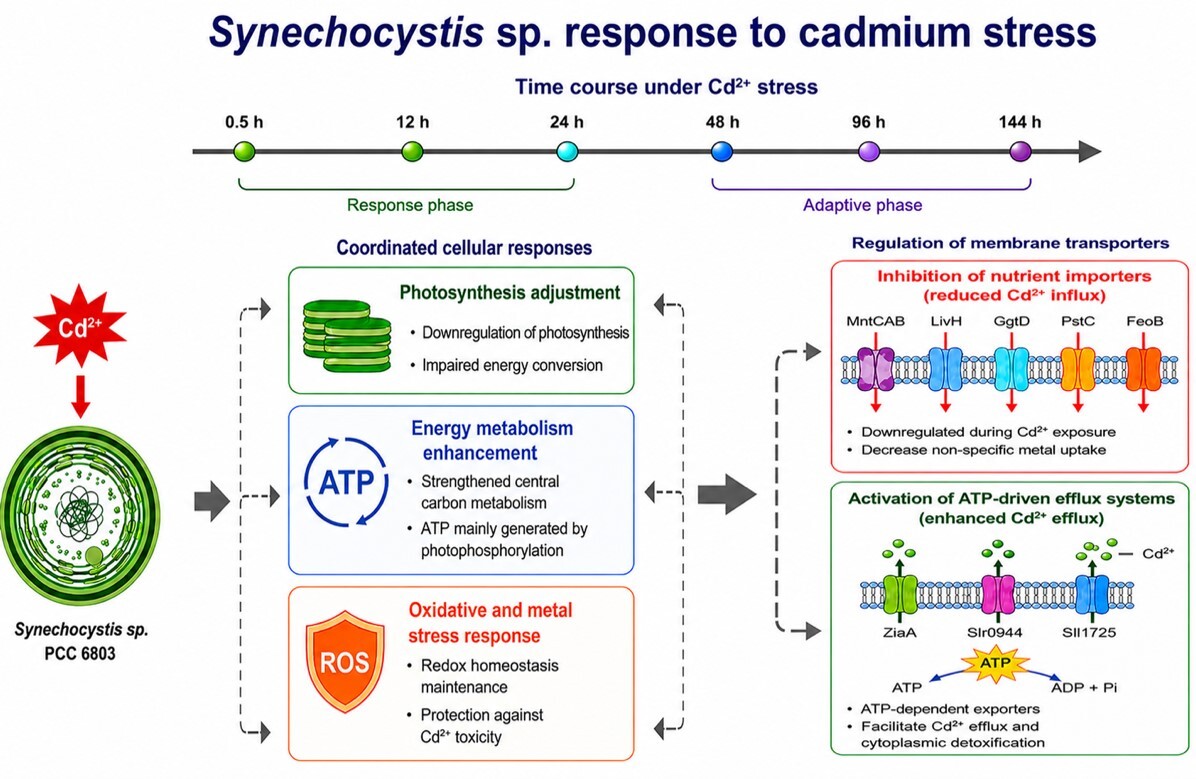
Schematic illustration of the two-stage response model of Synechocystis sp. PCC 6803 under low-level cadmium stress. (image by IHB)
(Editor: MA Yun)