Highlights
SET7 Regulates Antiviral Immunity Through Lysine Methylation of IRF3
A research group led by Prof. XIAO Wuhan from the Institute of Hydrobiology (IHB) of the Chinese Academy of Sciences, has identified the lysine-specific methyltransferase SET Domain Containing lysine methyltransferase 7 (SET7) as a critical negative regulator of antiviral innate immunity. SET7 directly catalyzes the monomethylation of IRF3 at the lysine 98 residue, which potently suppresses IRF3 activation. The study has been published in the Proceedings of the National Academy of Sciences (PNAS).
In this study, the researchers discovered that SET7 attenuates host antiviral immune response in an enzymatic activity-dependent manner. During infection with either RNA or DNA viruses, genetic disruption of SET7 or pharmacological inhibition of its methyltransferase activity enhances antiviral gene expression and inhibits virus replication.
Mechanistically, the researchers revealed that SET7 interacts with IRF3 and catalyzes its monomethylation at lysine 98. This methylation modification decreases IRF3 phosphorylation, dimerization, and subsequent nuclear translocation, thereby inhibiting the production of downstream type I interferons.
Using mice and zebrafish as in vivo models, the researchers demonstrated that Set7-deficient mice and zebrafish display significantly enhanced resistance to viral infection.
This study discovers a previously unrecognized post-translational modification of IRF3 that modulates its activation, and elucidates a novel biological function of SET7 in innate antiviral immune regulation. Importantly, these findings offer a promising molecular target for the genetic breeding of new fish strains with enhanced viral resistance.
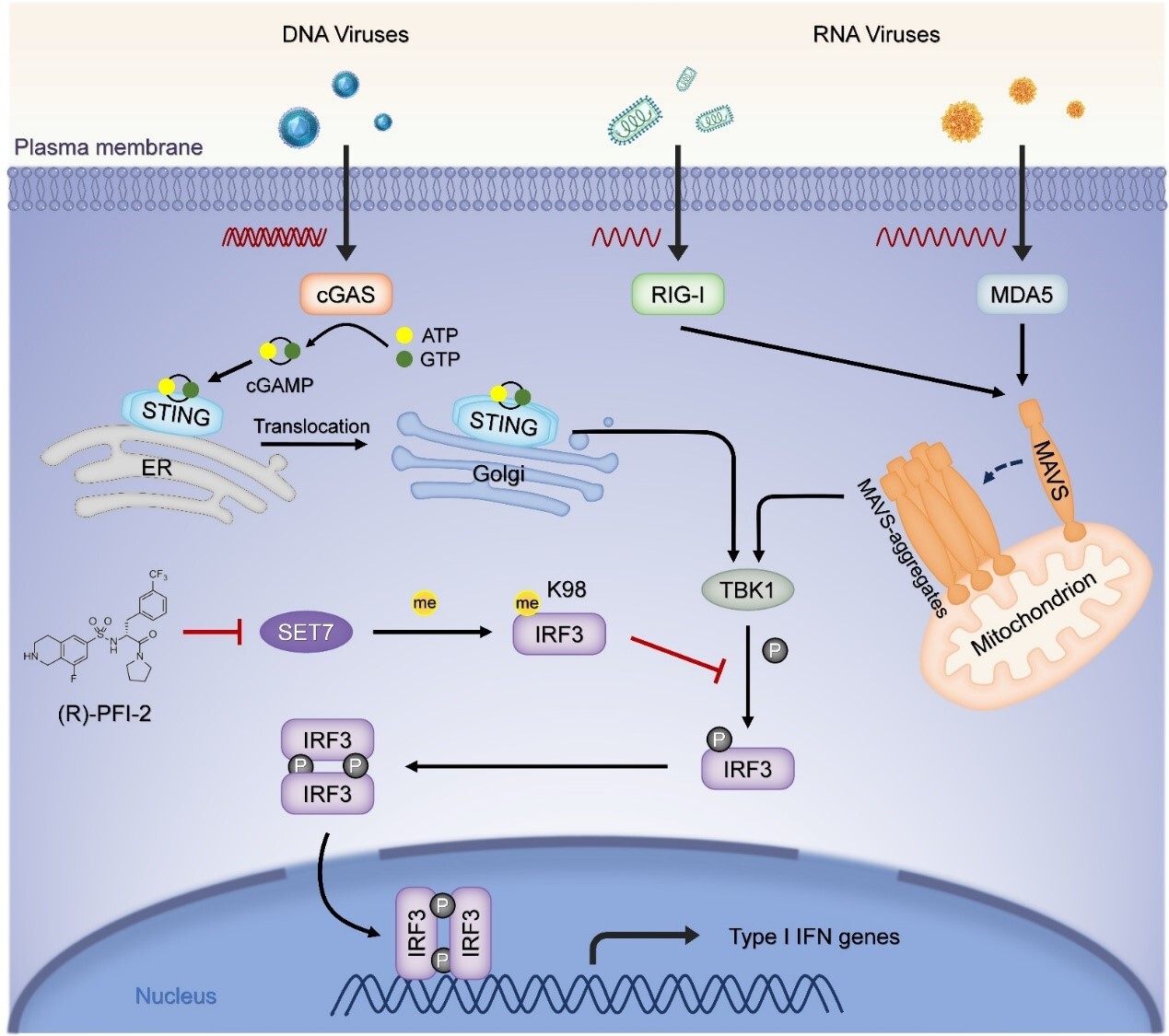
The working model of SET7 in antiviral innate immunity (Image by IHB)
(Editor: MA Yun)