Highlights
Study Uncovers Mechanisms Governing the Stability of Sediment Reducing Capacity
Sediment reducing capacity (RC) is a key indicator of benthic habitat quality. Its stability influences the biogeochemical cycling of organic carbon, nutrients, and pollutants in aquatic systems. RC consists mainly of reducing organic substances (RedOr), ferrous iron [Fe(II)], and reduced sulfur species (Sn, −2 ≤ n < 0).
In natural waters, wind-driven waves, bioturbation, and water-level fluctuations continually expose the sediment-water interface to alternating oxic and anoxic conditions. However, how these redox oscillations affect sediment RC and its components, and what controls their stability, remain unclear.
Recently, a research group led by Prof. LI Qingman from the Institute of Hydrobiology (IHB) of the Chinese Academy of Sciences reported their findings in Environmental Science & Technology. The study reveals the dynamics and stability mechanisms of sediment RC and its key components, and provide a scientific basis for refined classification and targeted management of aquatic sediments.
The researchers collected surface sediments from Honghu Lake (HH), Xiashan Reservoir (XR), Yudong Reservoir (YR), and Zhanghe Reservoir (ZR). They conducted controlled redox-alternation incubations and tracked changes in sediment RC and its major reducing components. Iron speciation analyses were also used to identify the mechanisms governing RC stability in different reductive sediment types.
Based on the compositive reducing capacity index, sediments from Honghu Lake and Xiashan Reservoir were classified as RedOr-Sn type, whereas sediments from Yudong Reservoir and Zhanghe Reservoir were classified as RedOr-Fe(II) type. During the 54-day experiment, sediments underwent four stages: initial anoxia, oxidation, renewed anoxia, and reoxidation.
RC in both sediment types followed the same general pattern: it decreased during oxidation, recovered under anoxia, and declined again upon reoxidation. However, the magnitude of change was much greater in RedOr-Sn sediments. During the anoxic recovery stage, RC in RedOr-Sn sediments increased by 97.5 ± 61.5 cmol e⁻ kg⁻¹ DW on average, 4.2 times that in RedOr-Fe(II) sediments. During reoxidation, RC in RedOr-Sn sediments decreased by 102.0 ± 61.1 cmol e⁻ kg⁻¹ dry weight (DW), approximately three times the decline observed in RedOr-Fe(II) sediments. These results indicate that RedOr-Sn sediments are more sensitive to redox alternation.
The contributions of individual reducing components also differed between sediment types. RedOr was the dominant driver of RC variation in RedOr-Sn sediments, contributing 55.8%, 79.0%, and 78.7% during oxidation, anoxic recovery, and reoxidation, respectively. In RedOr-Fe(II) sediments, Fe(II) made a much greater contribution to RC dynamics, whereas reduced sulfur species contributed relatively little. These results show that RedOr broadly governs RC dynamics, while the relative roles of Fe(II) and Sn depend on sediment reductive type.
The stability of sediment RC ultimately depends on the abundance and reactivity of its reducing components. Under anoxic conditions, RedOr-Sn sediments showed simultaneous increases in the abundance and reactivity of RedOr, Fe(II), and Sn. By contrast, RedOr-Fe(II) sediments mainly showed enhanced Fe(II) reactivity, with limited changes in RedOr and Sn.
Further analyses revealed that the contrasting RC stability of the two sediment types is associated with distinct iron-cycling mechanisms. RedOr-Sn sediments contained relatively low levels of easily reducible and reducible Fe(III) fractions, while magnetite-associated iron was more prominent. Under anoxic conditions, the limited reactive Fe(III) pool was rapidly consumed. Magnetite and sulfate subsequently became more important electron acceptors, promoting the accumulation of reducing substances and increasing sediment RC.
In contrast, RedOr-Fe(II) sediments contained abundant easily reducible and reducible Fe(III), which together accounted for an average of 65.7% of total iron. These reactive Fe(III) phases could accept electrons released from electron donors under anoxia, thereby limiting the accumulation of reducing substances and maintaining relatively stable RC.
Based on these mechanisms, the researchers proposed differentiated management strategies for different sediment types. For RedOr-Sn sediments, management should prioritize limiting RedOr accumulation and sulfide formation. For RedOr-Fe(II) sediments, efforts should focus on maintaining reversible iron cycling and stabilizing the pool of reactive Fe(III).
This study introduces a new approach to identifying reductive sediment types through artificially induced redox perturbations and reveals the key reducing components governing RC dynamics, providing a mechanistic basis for sediment risk diagnosis and type-specific management.
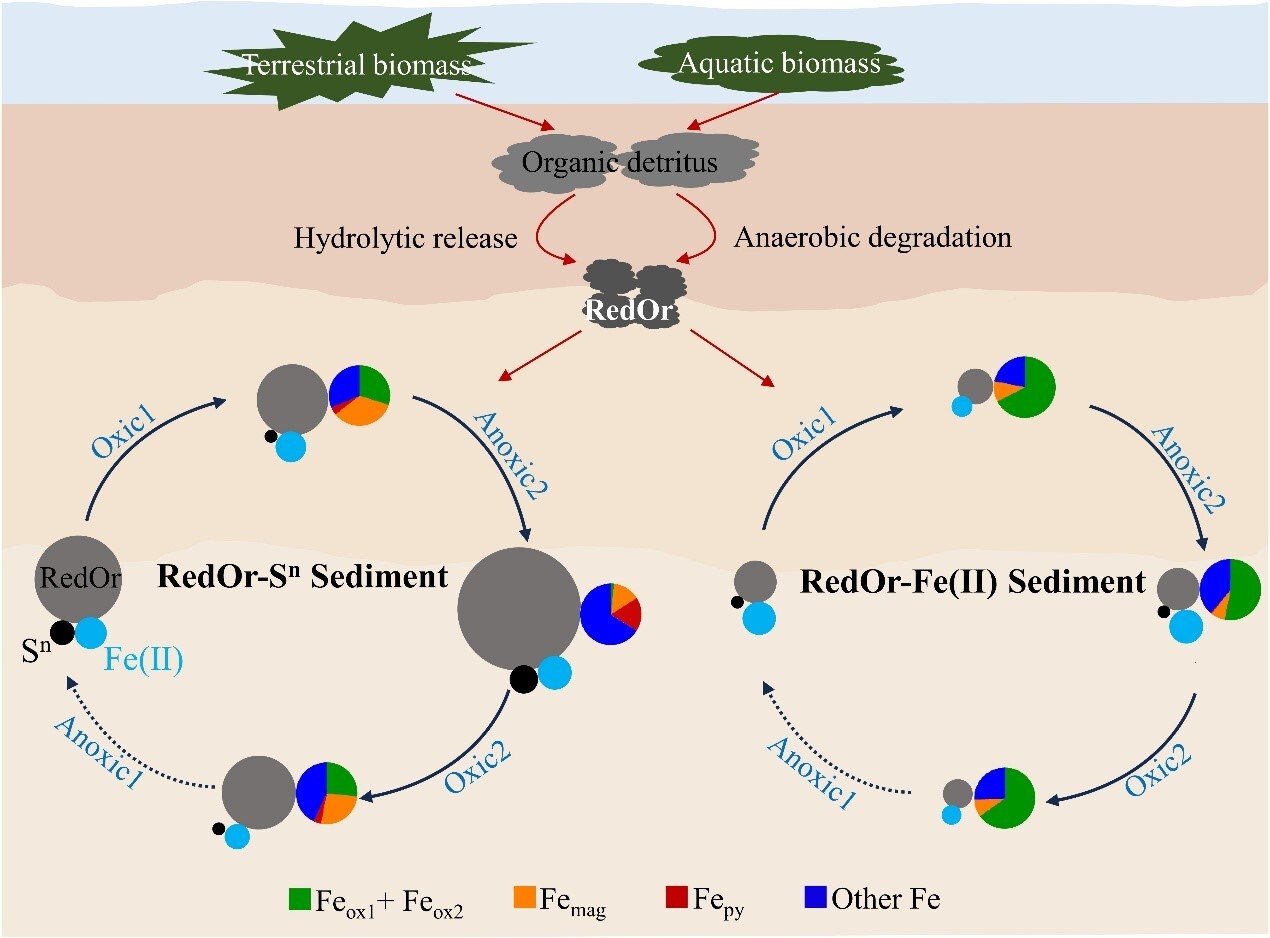
Conceptual model of RC dynamics, component changes, and iron cycling in RedOr-Sn and RedOr-Fe(II) sediments. (Image by IHB)
(Editor: MA Yun)