Newsroom
Prof. Sébastien Brosse from University of Toulouse Visits IHB
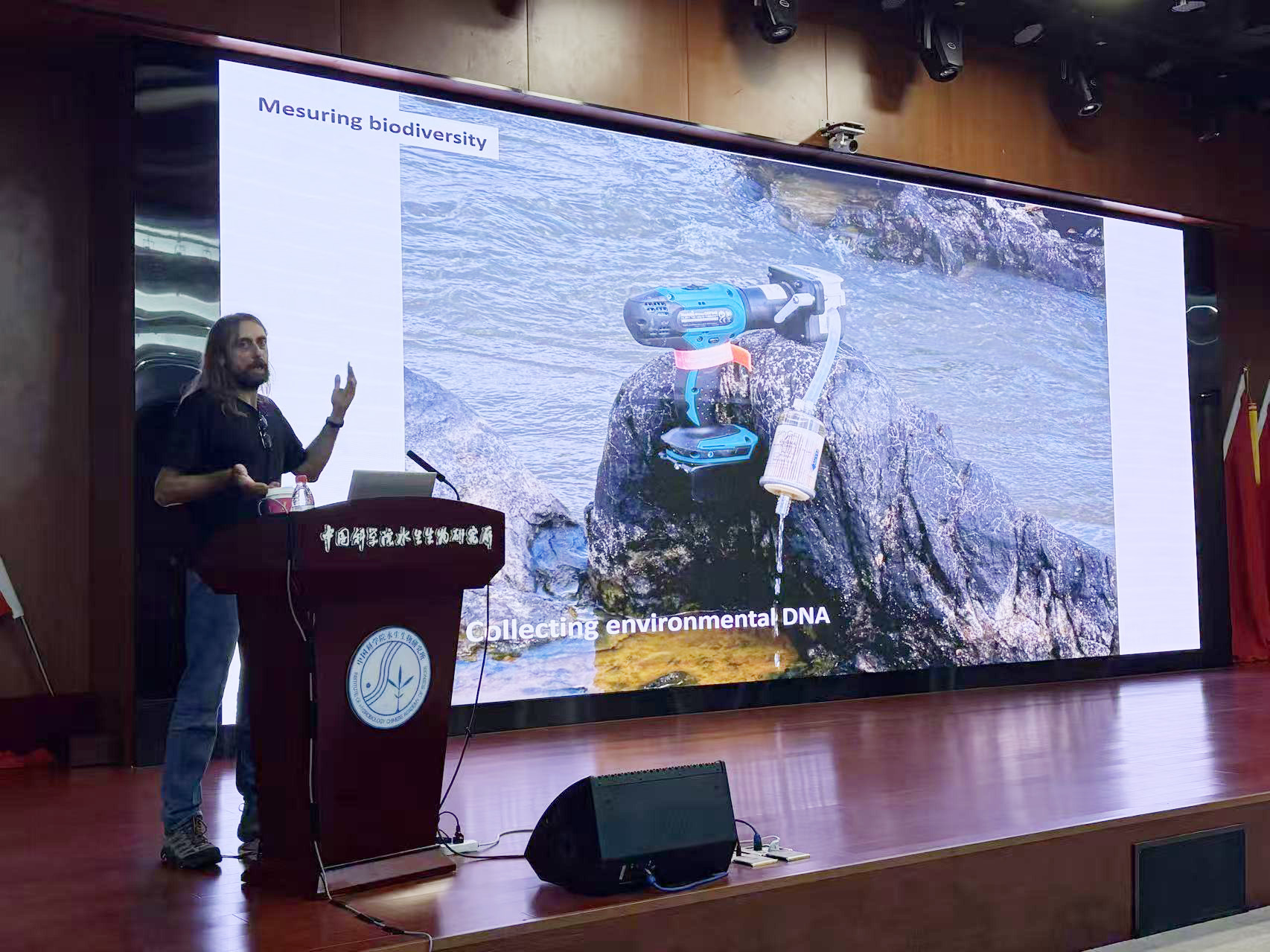
Prof. Sébastien Brosse of the University of Toulouse visited IHB on June 12, 2026. (Credit: IHB)
On the afternoon of June 12, 2026, Prof. Sébastien Brosse of the University of Toulouse visited the Institute of Hydrobiology (IHB) of the Chinese Academy of Sciences to present a lecture titled “Patterns, Threats, and Conservation Strategies for Freshwater Fish Diversity Across the Globe.”
In his presentation, Prof. Brosse offered a synthetic view of the distribution patterns of freshwater fish diversity at both global and regional scales, with particular attention to anthropogenic pressures. He highlighted the emerging phenomenon of biotic homogenization driven by non-native species introductions and discussed its ecological repercussions. He also presented recent methodological advances in environmental DNA (eDNA) metabarcoding for fish monitoring, sharing validation results and field insights from his team’s work in the tropical rainforest catchments of French Guiana.
Notably, he showed that even very low-intensity deforestation in upstream headwaters can have measurable negative effects on downstream fish communities, reducing both species richness and functional diversity. Turning to policy, Prof. Brosse pointed to China’s decade-long fishing moratorium on the Yangtze River as a compelling example of how strong regulatory intervention can support fish stock recovery and ecosystem restoration.
The lecture drew an audience of more than 100 IHB researchers and graduate students, and was followed by an engaged discussion covering eDNA applications, spatial analysis of functional traits, and large-scale river basin conservation.
Prof. Sébastien Brosse is a full professor at the Centre for Biodiversity and Environmental Research (CRBE) at the University of Toulouse, where he leads the research group on Aquatic Ecology and Global Change. A widely recognized figure in functional ecology and macroecology, his work centers on global freshwater biodiversity patterns, biogeography, and the ecological impacts of global change. He has spearheaded the development of FISHMORPH, a global database of fish morphological traits, and co-created one of the world’s most comprehensive riverine fish distribution databases. His research has appeared in leading journals including Science, Nature Communications, and PNAS, providing foundational data and analytical frameworks for freshwater science and conservation worldwide.