
Newsroom
International Day of Peace Delegates Visit IHB Guanqiao Campus

Nearly 100 Chinese and foreign guests attending the 2026 International Day of Peace commemorative event in Wuhan visited the Institute of Hydrobiology (IHB) of the Chinese Academy of Sciences on Sept. 21, 2026. (Credit: IHB)
Nearly 100 Chinese and foreign guests attending the 2026 International Day of Peace commemorative event in Wuhan visited the Institute of Hydrobiology (IHB) of the Chinese Academy of Sciences on Sept. 21, 2026.
The event, co-hosted by the Chinese People's Association for Peace and Disarmament and the People's Government of Hubei Province, was held under the theme "Meet Challenges together for a Peaceful World."
Accompanied by IHB deputy director XU Jun, the guests toured the Yangtze Cetacean Breeding and Conservation Center and the Museum of Hydrobiological Sciences. Among them were Sergei Nikolayevich Baburin, chairman of the International Union of the Russian Peace Foundation and former deputy chairman of the Russian State Duma; Andrei Zherdev, head of Asian cooperation at the Russian Peace Foundation's international union; and representatives of peace organizations, research institutions and youth groups from Sudan, Guinea, Iraq, Zambia, Zimbabwe, South Africa and Ethiopia.
QIAN Hongshan, former vice minister of the International Department of the CPC Central Committee and advisor to the Chinese People's Association for Peace and Disarmament, and other association members also attended.
Hao Yujiang, director of the Yangtze Cetacean Breeding and Conservation Center, briefed the guests on the center's decades of work in translocation conservation, artificial breeding and population recovery of the Yangtze finless porpoise. At the porpoise rearing pools and the Freshwater Cetacean Specimen Exhibition, guests observed the porpoises and viewed rare specimens and live fish, gaining a direct sense of China's progress in freshwater aquatic biodiversity conservation and biological resource preservation.
At the Museum of Hydrobiological Sciences, the guests learned about China's rich freshwater biological resources through specimens and public education displays. They praised the results of Yangtze River conservation and Yangtze finless porpoise protection, saying the Yangtze ecological restoration offers a Chinese approach that can be referenced for global biodiversity conservation and helps build consensus on a shared peaceful and healthy ecological home.
The visit used aquatic biodiversity and conservation as a link to show foreign guests the results of China's Yangtze River conservation, adding an ecological dimension to peace exchanges.
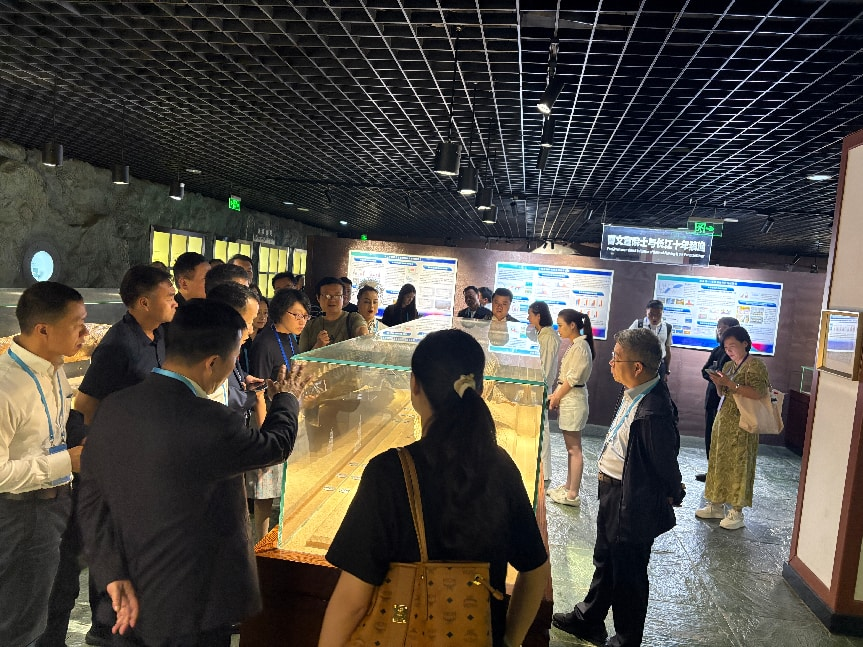
At the Museum of Hydrobiological Sciences, the guests learned about China's rich freshwater biological resources through specimens and public education displays. (Credit: IHB)