Newsroom
Professor from CAS Institute of Oceanology Visits IHB
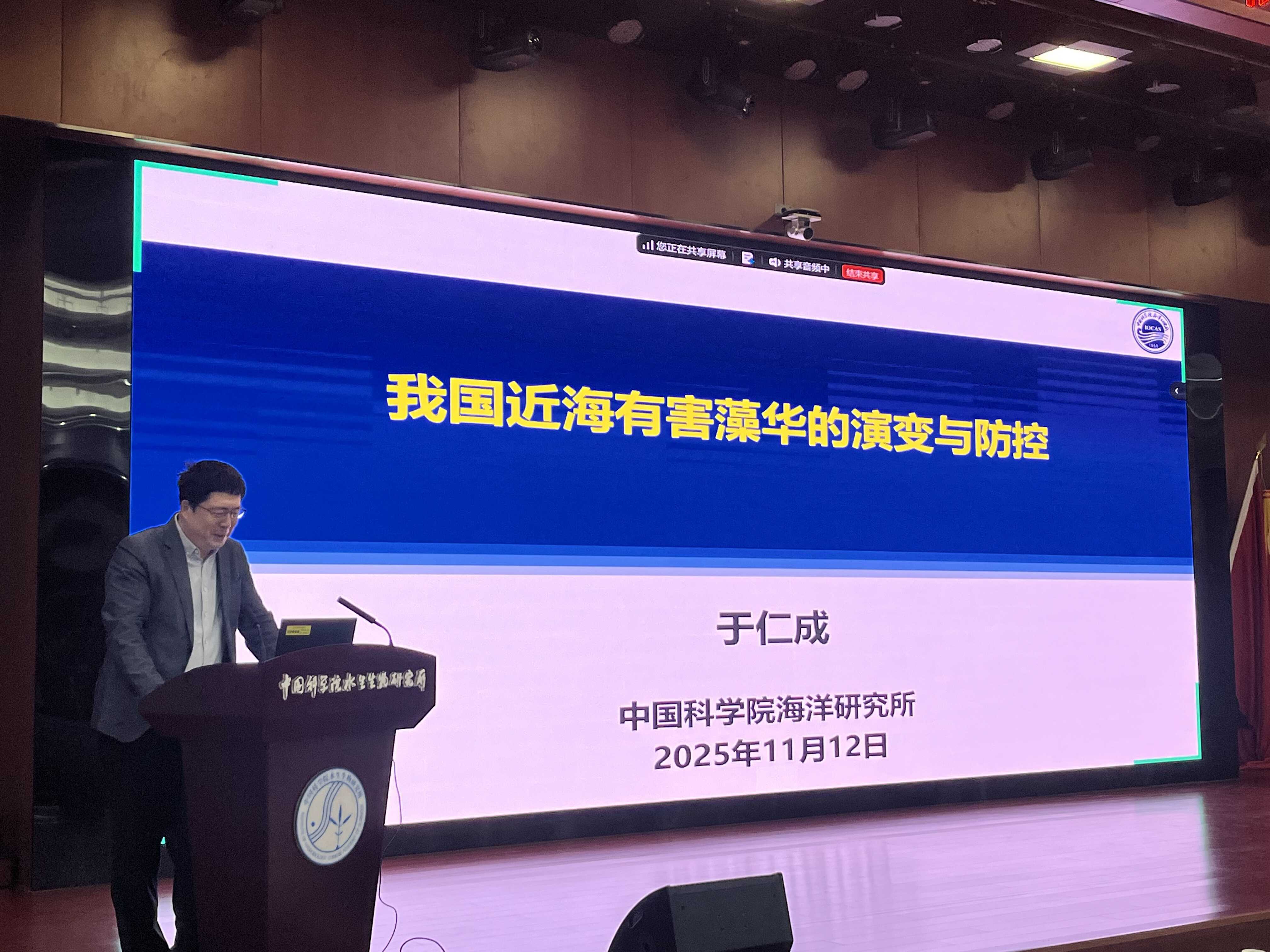
Prof. YU Rencheng from the Institute of Oceanology of the Chinese Academy of Sciences visited IHB on November 12, 2025. (Credit: IHB)
Prof. YU Rencheng from the Institute of Oceanology of the Chinese Academy of Sciences (CAS), was invited to the Institute of Hydrobiology (IHB) of the Chinese Academy of Sciences on November 12, 2025, for an academic exchange. He presented an academic lecture titled "The Evolution and Prevention of Harmful Algal Blooms in China's Coastal Waters" for IHB researchers and graduate students.
In his presentation, Prof. Yu systematically introduced the global status and key drivers of harmful algal blooms (HABs) in marine and freshwater ecosystems. He reviewed the processes, research progress, and response strategies related to HABs in China's coastal waters, with detailed analysis of several case studies, including dinoflagellate blooms in the Yangtze River Estuary, toxic algal blooms in Qinhuangdao, and winter dinoflagellate blooms on the Shandong Peninsula.
Long-term studies indicate that land-based nutrient inputs and the nearshore Kuroshio Current branch play key roles in regulating dinoflagellate blooms in the Yangtze River Estuary area. Prof. Yu noted that predicting dominant species and impacts of large-scale dinoflagellate blooms in the East China Sea remains challenging.
Toxic dinoflagellate blooms pose heightened risks to marine life and human health. Using the Qinhuangdao Alexandrium bloom as an example, Prof. Yu explained the toxin-producing species and formation mechanisms involved. He highlighted the lack of efficient and specific detection methods, which hampers effective management. He also noted that climate change-driven extreme weather may significantly influence bloom dynamics.
In conclusion, Prof. Yu emphasized the challenges in understanding HAB evolution in China's coastal seas and underscored the need for a next-generation integrated prevention and control system for toxic and harmful algal blooms.