Newsroom
Wuhan Delegation Visits IHB to Deepen Yangtze Finless Porpoise Protection and Cultural-Tourism Integration
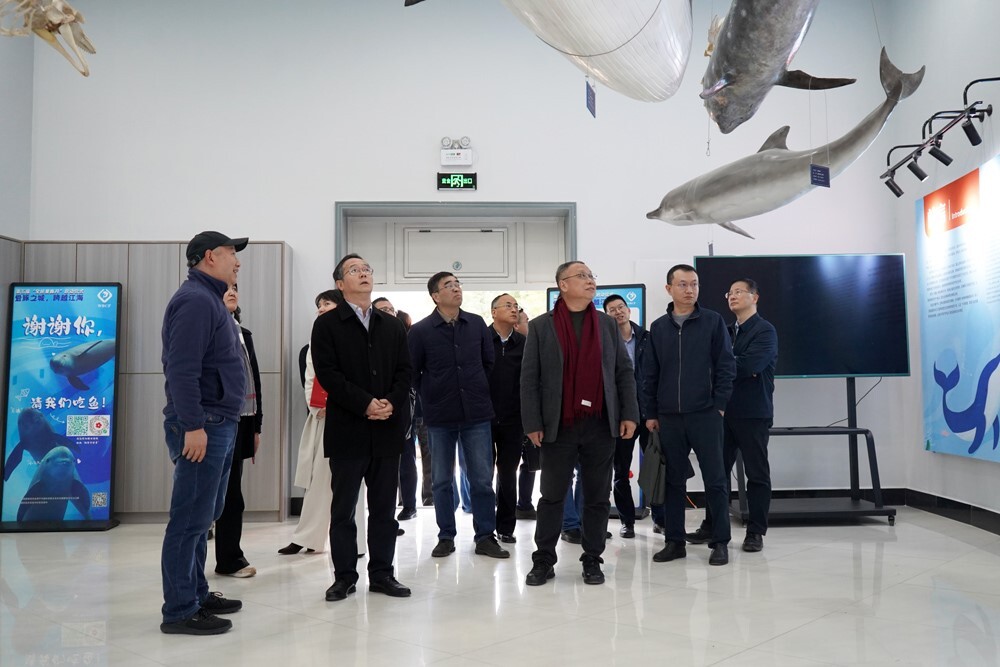
A delegation led by Wu Chao'an, Member of the Standing Committee of the Wuhan Municipal CPC Committee and Director of the Communication Department, visited the Baiji Dolphinarium on December 3, 2025. (Credit: IHB)
A delegation led by Wu Chao'an, Member of the Standing Committee of the Wuhan Municipal CPC Committee and Director of the Communication Department, visited the Institute of Hydrobiology (IHB) of the Chinese Academy of Sciences on December 3, 2025 to advance conservation efforts for the Yangtze finless porpoise and explore new ways to integrate environmental protection with public education and sustainable tourism.
The visit centered on the Baiji Dolphinarium, where city officials met with IHB leadership and lead scientists to discuss the progress of the "Finless Porpoise Returns to Wuhan" initiative. This program has seen significant success following the implementation of a comprehensive fishing ban on the Yangtze River.
Prof. ZHENG Jinsong reported that four distinct porpoise groups have now established permanent habitats within the Wuhan stretch of the river, specifically in the Jinkou, Tianxingzhou, Shuangliu, and Hannan waters.
A major milestone in the city's conservation strategy was the establishment of the Wuhan Yangtze Finless Porpoise Breeding and Conservation Technology Research Center. Supported by municipal funding, the center has achieved scientific breakthroughs, including the successful birth of two second-generation porpoises through captive breeding. The facility also hosts the world’s first specialized sperm bank for endangered cetaceans, a critical asset for the long-term genetic diversity of the species.
During the site inspection, Wu Chao’an emphasized a three-pillar strategy for the future: advancing scientific breeding techniques, developing a phased roadmap for eco-tourism and public science education, and establishing the finless porpoise as a primary symbol of Wuhan’s environmental identity.
XIE Shouqi, deputy director of the IHB, noted that the institute is modeling its future growth on the world-renowned Chengdu Research Base of Giant Panda Breeding. By leveraging its current research facilities, the IHB plans to create a flagship destination that combines world-class laboratory work with public-facing conservation programs and eco-friendly tourism.