Newsroom
Prof. HE Shunping Delivers Lecture on Fish Evolution and Deep-Sea Adaptation at IHB
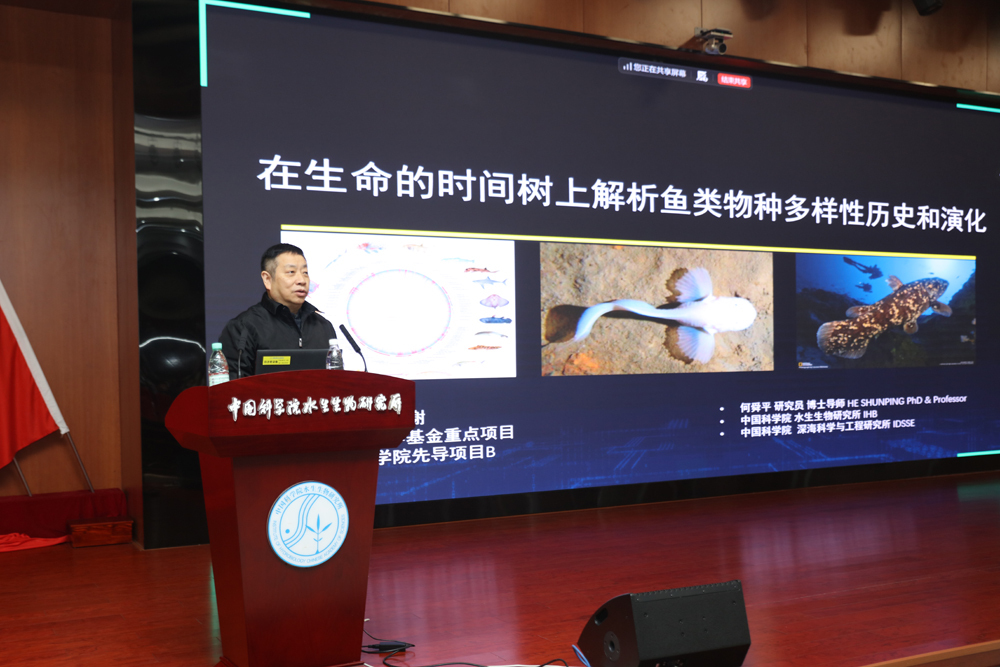
Prof. HE Shunping (CAS member), a distinguished ichthyologist and evolutionary biologist from IHB, delivered a keynote lecture on January 22, 2026. (Credit: IHB)
Prof. HE Shunping (CAS member), a distinguished ichthyologist and evolutionary biologist from the Institute of Hydrobiology (IHB) of the Chinese Academy of Sciences, delivered a keynote lecture on January 22, 2026, titled "Constructing the Tree of Life: Unraveling the Evolutionary Dynamics of Fish Biodiversity."
Opening his presentation with a fundamental reexamination of what defines a "fish," Prof. He positioned fish as non-tetrapod jawed vertebrates, emphasizing their unique evolutionary status. He systematically reviewed the spatial and temporal dynamics of global fish diversity, offering a comprehensive overview of current research trajectories.
A significant portion of the lecture was dedicated to the evolution of ray-finned fishes. He highlighted breakthroughs from the "Fish10K" genome project, revealing that LINE transposable elements in teleost fish exhibit a dynamic equilibrium model of evolution. He further proposed a "third driving force" behind fish diversification, identifying specific non-coding conserved sequences that play critical regulatory roles in evolution.
In a compelling intersection of geology and biology, He presented evidence linking the origin and evolution of East Asian cyprinid fishes to historical shifts in the East Asian monsoon. This finding, he noted, not only provides key molecular evidence for biogeography but also opens new directions for the development of fish germplasm resources and selective breeding.
Addressing one of evolution's most profound transitions, the shift from aquatic to terrestrial life, He's team reconstructed the giant lungfish genome using innovative algorithms. The analysis uncovered a three-step evolutionary pathway for air-breathing capacity, adaptive mechanisms in motor and neural systems, and key genetic elements associated with limb development. Remarkably, the research also traced the establishment of anti-anxiety emotional responses to early evolutionary stages, providing multidimensional molecular evidence for tetrapod origins.
He's pioneering work on the origin and adaptation of deep-sea and hadal fishes was recently named one of China’s Top 10 Life Science Advances of 2025. Overcoming significant technical hurdles, his team conducted high-risk manned submersible operations in the Mariana-Yap Trench convergence zone, successfully collecting rare biological specimens. Functional genomic analyses identified key genes, including BGP and TMAO oxidase, that are crucial for regulating osmotic balance and maintaining protein structural stability under extreme pressure conditions. He elucidated a dual evolutionary model for deep-sea communities: while most lineages colonized these environments relatively recently, a few ancient lineages adapted to hadal conditions much earlier and survived multiple mass extinction events.
HE Shunping serves as vice president of the China Zoological Society, chairman of its Ichthyology Division, and president of the Hubei Zoological Society. Elected as a member of the Chinese Academy of Sciences, his research focuses on fish taxonomy, biogeography, and evolutionary biology.
By integrating novel methodologies with long-term systematic taxonomic work, He has advanced ichthyological research to encompass pattern, process, and mechanism. His systematic innovations cover extreme environmental adaptation in hadal fish, genetic innovations underlying vertebrate terrestrialization, and the phylogenetic evolution of East Asian freshwater fishes. Over a 40-year career, he has authored more than 270 papers, including three as corresponding or co-corresponding author in Cell, as well as publications in Nature Ecology & Evolution, Genome Research, and National Science Review.