Newsroom
National Fisheries Technology Extension Center Visits IHB to Investigate Aquaculture Disease Prevention Efforts
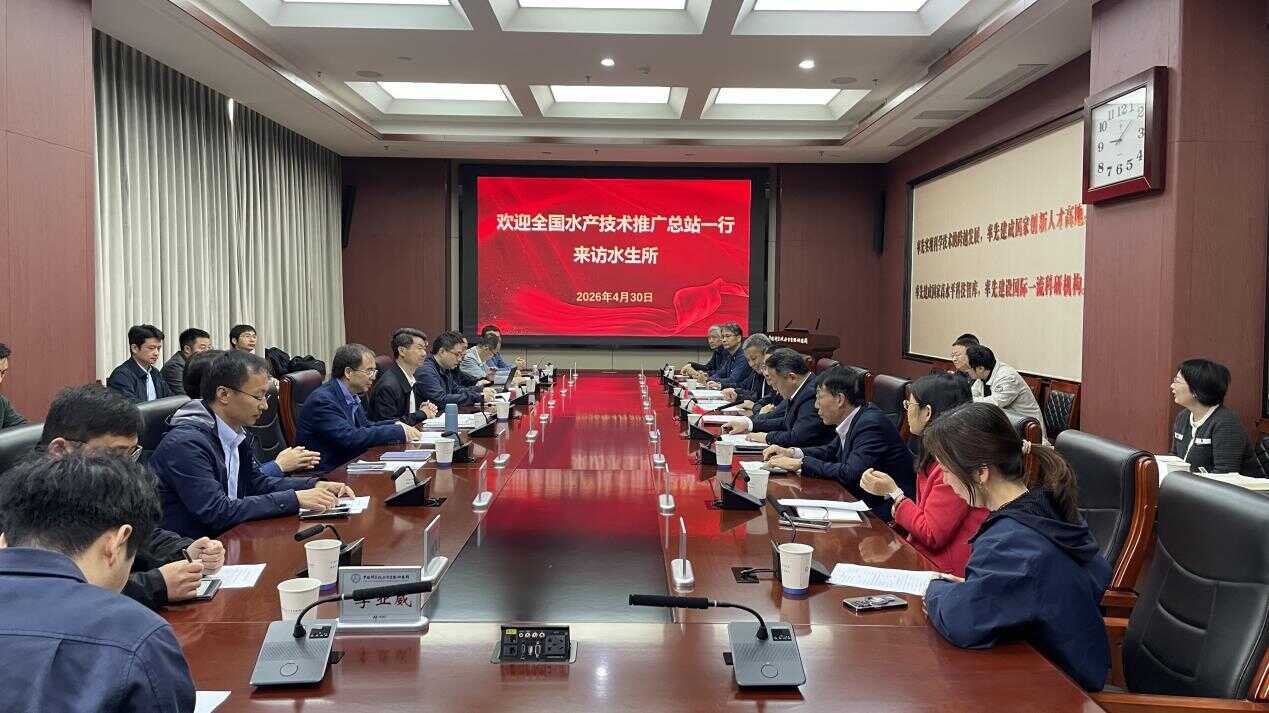
A high-level expert team convened on April 30, 2026 at the Institute of Hydrobiology (IHB) of the Chinese Academy of Sciences to investigate the current landscape of disease prevention and control in aquaculture. (Credit: IHB)
A high-level expert team convened on April 30, 2026 at the Institute of Hydrobiology (IHB) of the Chinese Academy of Sciences to investigate the current landscape of disease prevention and control in aquaculture. The meeting, organized by the National Fisheries Technology Extension Center (NFTEC), brought together more than 30 leading specialists and policymakers from key institutions across the country.
Participants included representatives from the China Rural Technology Development Center, Sun Yat-sen University, Fujian Agriculture and Forestry University, and Huazhong Agricultural University. Also joining were the Yellow Sea Fisheries Research Institute and the Yangtze River Fisheries Research Institute, both under the Chinese Academy of Fishery Sciences.
MIAO Wei, director of IHB, opened the meeting by welcoming the delegation and outlining the institute’s capabilities in aquatic disease research, breeding, and ecological aquaculture, stressing the importance of aligning scientific output with industry needs.
The investigation, initiated by the China Rural Technology Development Center and led by NFTEC, aims to distil frontline technological challenges into actionable priorities for national science planning during the 15th Five-Year Plan period and beyond. SUN Kangtai, from the Rural Technology Development Center, noted that aquatic animal disease control had emerged as one of the most frequently raised concerns among industry stakeholders, making it a central focus of the investigation.
XU Zhen, deputy director of IHB, presented recent advances in fish disease research, highlighting key progress made by the institute in pathogen identification, immune mechanism analysis, disease-resistant breeding, and vaccine development.
Experts discussed a wide range of issues related to aquaculture disease control, including vaccine development, the relationship between farming practices and disease outbreaks, antimicrobial resistance, rapid diagnostic technologies, the use of AI and big data in disease surveillance, as well as regulatory and outreach challenges.
CHEN Jiayong, deputy director of NFTEC, described the findings as highly productive, noting that the experts offered both technical innovations and practical regulatory suggestions. He identified three core challenges facing China’s aquaculture sector: product quality and safety, environmental sustainability, and biosecurity. Disease control, he said, serves as a crucial entry point for addressing the first two.
Chen called for a stronger emphasis on “preventive treatment” in aquaculture, accelerated construction of specified pathogen-free (SPF) breeding facilities, improved quarantine systems for aquaculture seed stocks, and expanded research and deployment of green control products, including vaccines, herbal remedies, and small-molecule drugs.
He concluded by confirming that NFTEC would synthesize the findings into a formal report to inform policy refinements and future project funding.