Newsroom
CAS Wuhan Branch Hosts Second "Wave-Chasing" Science Salon to Promote Scientific Values
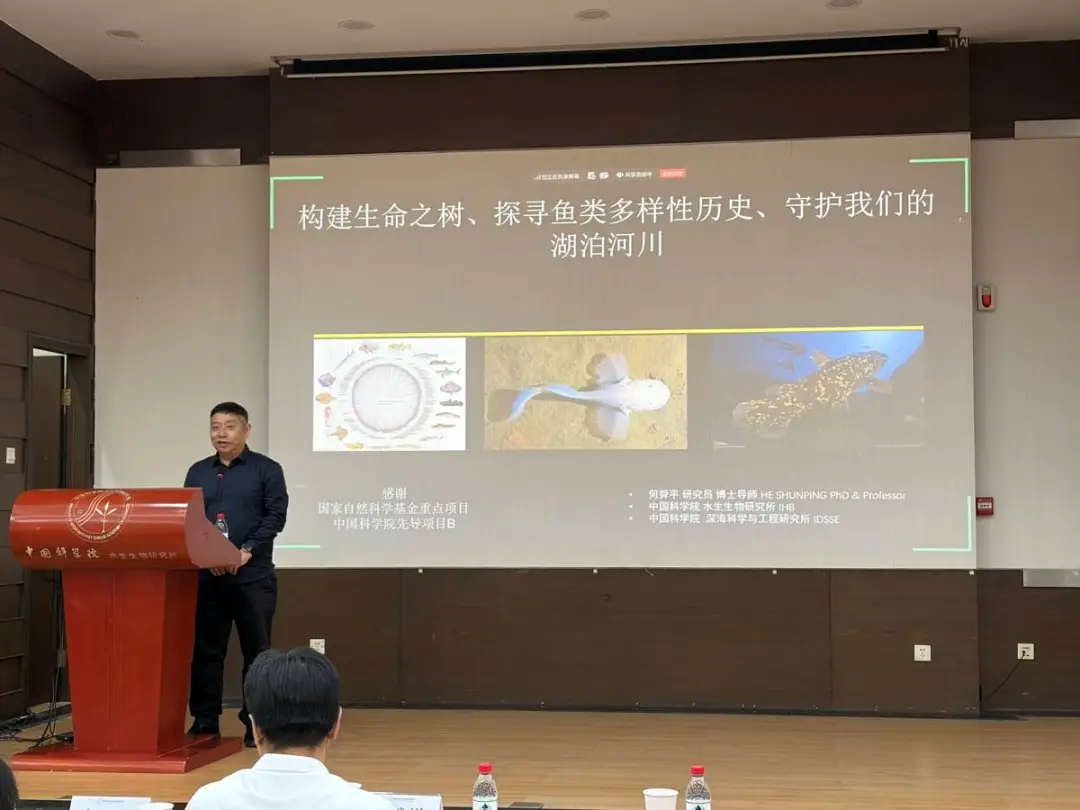
IHB Prof. HE Shunping, a CAS member, delivered the keynote lecture. In a presentation that traced the evolutionary tree of vertebrates, (Credit: IHB)
The second "Wave-Chasing" Science Salon and the inaugural "Legacy Lecture Series," organized by the Wuhan Branch of the Chinese Academy of Sciences (CAS), opened on Thursday at the Institute of Hydrobiology (IHB) in Wuhan on May 21, 2026.
The event, themed "Spreading the Power of Science through Popularization, Forging a Path of Innovation with Scientific Values," attracted more than one hundred researchers, university students, and industry professionals.
MIAO Wei, director of IHB, opened the event by recalling the institute's ninety-year history of Yangtze River research. He described the "Wave-Chasing" salon as a platform for pursuing scientific frontiers while passing knowledge from one generation to the next.
GUAN Wuxiang, vice president of the CAS Wuhan Branch, urged researchers to stay true to their original aspirations and deepen basic research in support of ecological protection.
IHB Prof. HE Shunping, a CAS member, delivered the keynote lecture. In a presentation that traced the evolutionary tree of vertebrates, He explained the mechanisms behind fish diversity, the genetic adaptations of deep-sea fish to extreme pressure, and the progress of building a DNA barcode database for Yangtze River aquatic life.
During a Q&A session, He encouraged young researchers to pursue their interests with patience and persistence. "Genuine research depends on sustained curiosity and dedicated immersion," he said, drawing warm applause.
The event also featured a presentation by XU Dong, deputy director of the Wuhan Ecological and Environmental Science and Technology Center. In a presentation titled "A Drop of Water in the Great Yangtze River Protection," Xu shared his three-year journey across 30 Chinese provinces and regions to restore water ecosystems. He showed how scientific findings on Yangtze conservation can be translated into everyday knowledge through school and corporate outreach programs.
HAO Yujiang, director of the Yangtze River Finless Porpoise Breeding Research Center at IHB, delivered the closing presentation. He contrasted the functional extinction of the baiji, with the recent recovery of the Yangtze finless porpoise population.
Hao outlined three conservation strategies - in-situ protection, ex-situ protection, and artificial breeding. "Last year, for the first time, we released six finless porpoises back into the Yangtze River, marking a complete end-to-end solution for ex-situ protection," he said.
But he also noted emerging threats. "Recreational fishing has led to more porpoises swallowing fishhooks, and climate change-induced droughts are shrinking their habitats," Hao said. His team is now using acoustic monitors, drone surveillance, and AI analysis to track porpoises more accurately. "Our methods have been adopted by the IUCN and are now being used to protect Irrawaddy and Ganges river dolphins in Cambodia and Bangladesh," he added.
A separate youth symposium was held alongside the main event. Prof. LI Haidong from the CAS Innovation Academy for Precision Measurement Science and Technology and a recipient of the CAS Youth May Fourth Medal, shared his personal journey under the title "Practicing Scientific Values, Forging Ahead as Pioneers."
The event also included a policy briefing by LIANG Chen, deputy director of the Professional Technical Personnel Service Division at the Hubei Provincial Talent Service Center.
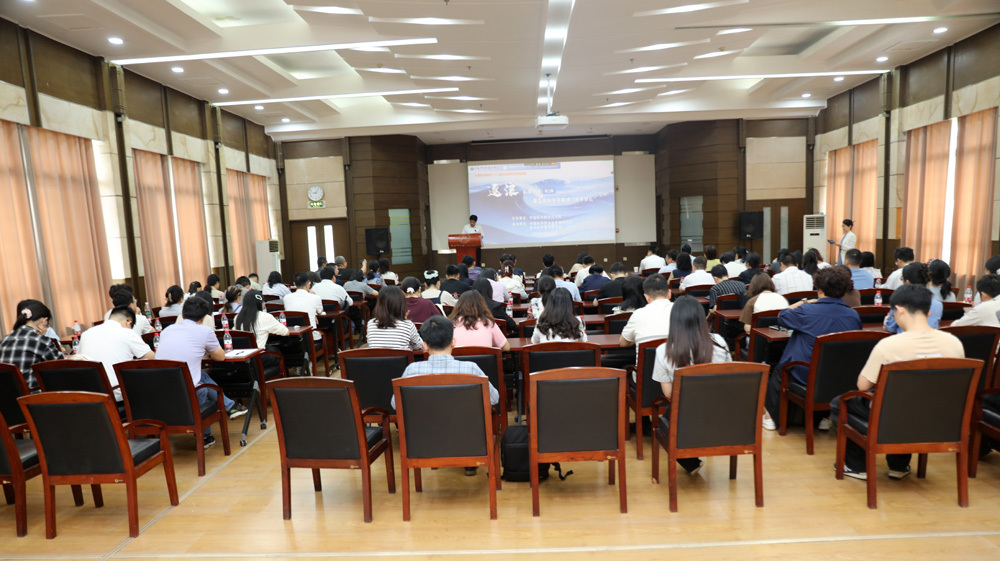
The second "Wave-Chasing" Science Salon and the inaugural "Legacy Lecture Series," organized by the Wuhan Branch of the Chinese Academy of Sciences (CAS), opened on Thursday at the Institute of Hydrobiology (IHB) in Wuhan. (Credit: IHB)