Newsroom
IHB Hosts Fourth Sci-Tech Capacity Forum: “AI – From Dialogue to Action”
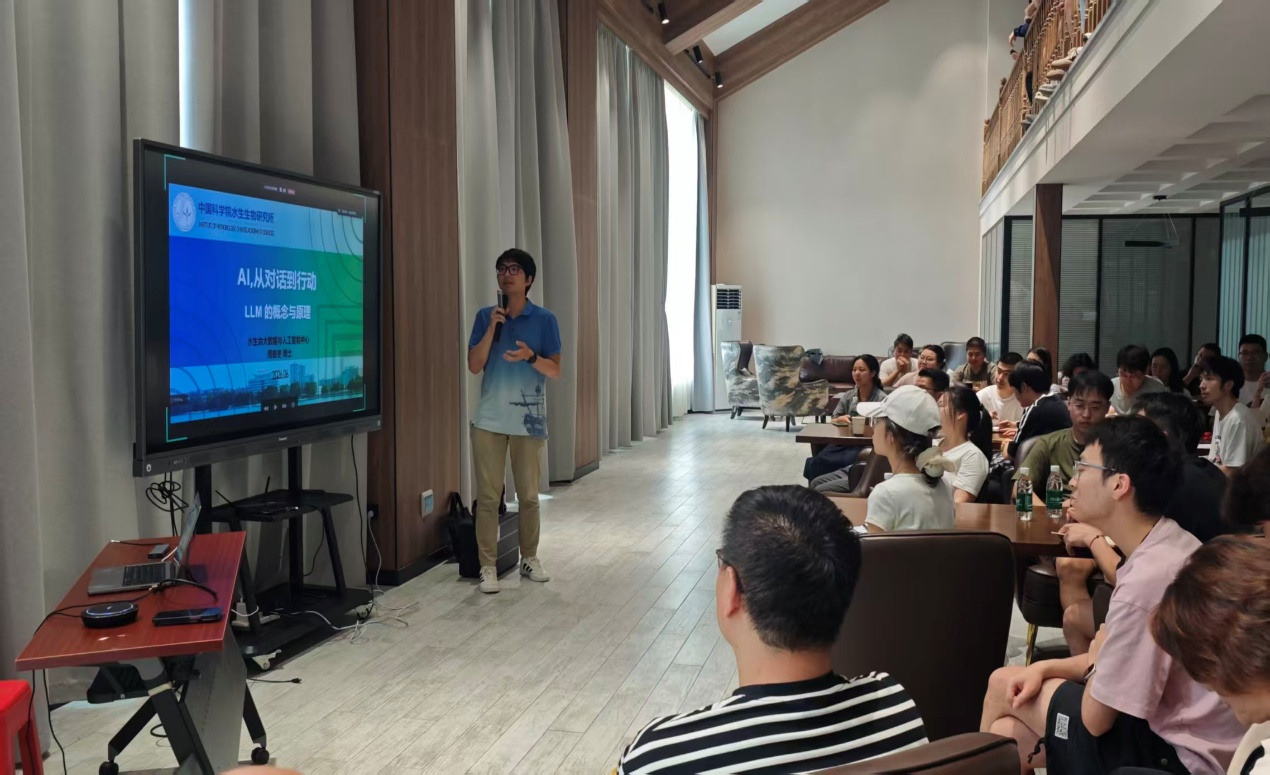
The Fourth Sci-Tech Capacity Forum of the Institute of Hydrobiology (IHB), Chinese Academy of Sciences, was held on June 2, 2026, under the theme "AI: From Dialogue to Action." (Credit: IHB)
The Fourth Sci-Tech Capacity Forum of the Institute of Hydrobiology (IHB), Chinese Academy of Sciences, was held on June 2, 2026, under the theme "AI: From Dialogue to Action." The forum brought together researchers, administrative staff, and graduate students for an in-depth exploration of the application prospects of AI agents in scientific research. Four speakers delivered presentations covering fundamental principles, application concepts, research automation, and disciplinary practices, offering a comprehensive overview of how AI agents are reshaping research workflows.
ZHOU Xiongdong, Associate Professor at the Center for Big Data and AI in Aquatic Life Sciences, opened the forum with a talk titled "Concepts and Principles of Large Language Models," in which he explained the operational essence of LLMs and introduced a three-tier framework along with a comparative analysis of mainstream AI tools.
Prof. XIONG Xiong followed with "AI Agents: From Chat to Work Assistant," using the analogy of treating an agent as a student to illustrate the architecture and emphasizing that the key to effective use lies in clear communication. He demonstrated practical cases including poster design, meeting minutes automation, and data analysis, and concluded that while agents can accelerate and streamline work, they cannot substitute for human judgment.
Dr. DING Liuyong presented on "Agent-Enabled Research Automation and Intelligent Fish Monitoring," focusing on the practical integration of AI agents into experimental workflow automation and intelligent fish monitoring. Through concrete case studies, he demonstrated the cutting-edge convergence of AI technologies with hydrobiological research.
Dr. QIAN Jianshuo addressed fish taxonomy, demonstrating three applications: fine-tuning the mT5 model to improve Chinese name translation for over 7,000 fish species by 38% to 159%, the "Know Fish" WeChat mini-program for intelligent identification of more than 9,000 species, and a fish morphology workstation with six functional modules. He stressed the importance of breaking complex academic tasks into manageable steps for reliable AI deployment.
Following the four presentations, attendees engaged in a lively and in-depth discussion with the speakers on topics including agent usage techniques, data security and privacy protection, and domestic alternatives to existing AI tools.
From foundational principles to hands-on practice, and from general-purpose applications to discipline-specific frontiers, the forum comprehensively showcased the new possibilities that AI agents bring to scientific research, and added renewed momentum to IHB's ongoing efforts to deepen the integration of artificial intelligence with hydrobiological research.