
Newsroom
Three Provinces Join Forces to Protect Rare Aquatic Species in Upper Yangtze River
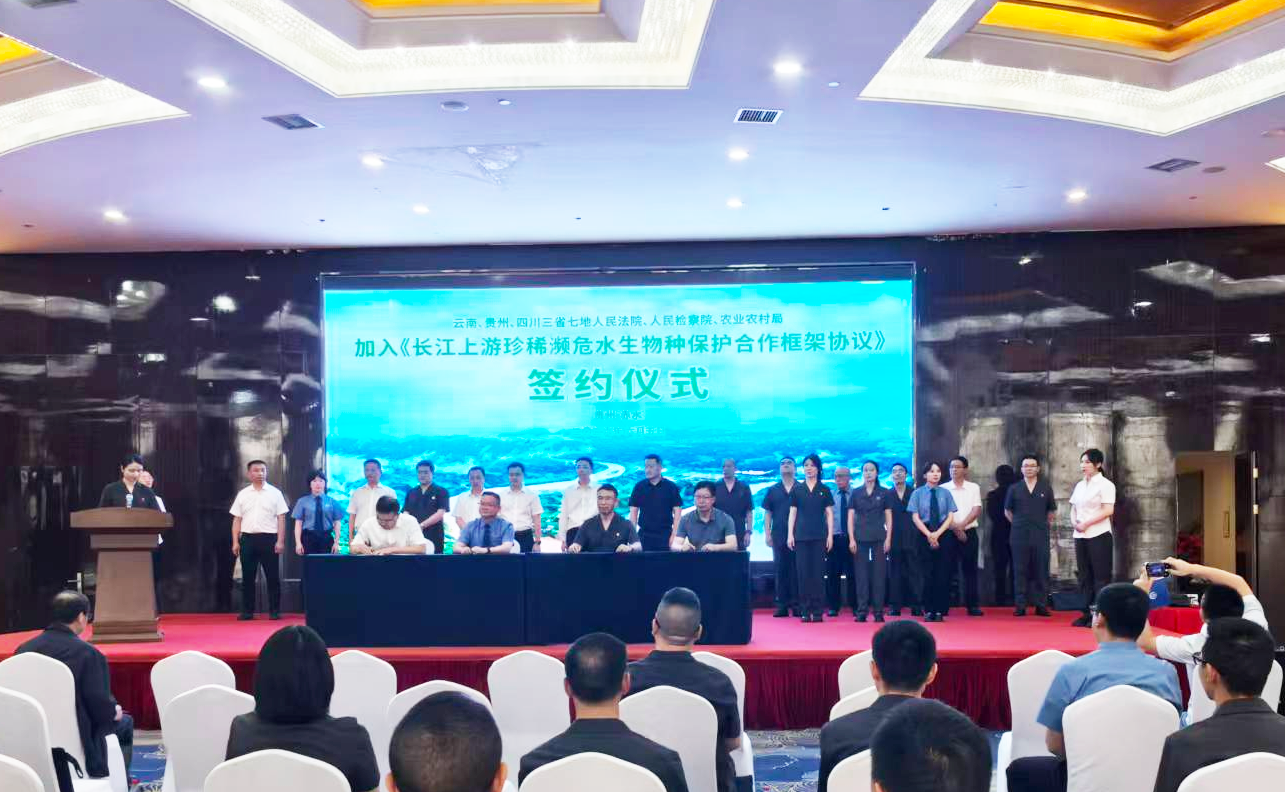
In a significant expansion of transboundary environmental cooperation, judicial and agricultural authorities from 19 cities and counties across three provinces signed a landmark agreement on June 5, 2026 to protect rare and endangered aquatic species in the upper Yangtze River basin. (Credit: IHB)
In a significant expansion of transboundary environmental cooperation, judicial and agricultural authorities from 19 cities and counties across three provinces signed a landmark agreement on June 5, 2026 to protect rare and endangered aquatic species in the upper Yangtze River basin.
The framework, signed in Chishui, brings together prosecutors, courts, and farm bureaus from seven jurisdictions across Yunnan, Guizhou, and Sichuan, creating a coordinated protection network spanning the entire Chishui River watershed. The river, a major undammed tributary of the Yangtze, serves as a critical refuge for species including the Yangtze sturgeon and is often described by scientists as the region's "last sanctuary" for endemic fish.
The agreement marks a decisive shift from piecemeal local efforts to a unified, multi-sector strategy that knits together law enforcement, scientific research, and ecological restoration. Under the new framework, case-related funds from environmental lawsuits will be channeled directly into species recovery work.
Speaking at the signing ceremony, XU Zhen, deputy director of the Institute of Hydrobiology (IHB) of the Chinese Academy of Sciences, said the cooperation had expanded from an initial tripartite arrangement in Chishui to a full-basin, multi-sector system that integrates judicial, administrative, and research capabilities.
The event was attended by a range of officials, including XU Zhen, ZHU Xing, president of the Zunyi Intermediate People's Court, and LUO Yonghong, secretary of the Political and Legal Affairs Committee of Chishui, along with representatives from Zhenxiong, Weixin, Renhuai, Gulin, Xishui, Xuyong, and Hejiang counties. Following the signing, the local court and prosecutor's office transferred restitution money to IHB for captive breeding, wild population recovery, and habitat rehabilitation of the Yangtze sturgeon and other threatened species.
At a subsequent workshop, participants shared experiences and challenges in ecological justice, administrative enforcement, and conservation research, and discussed cross-regional enforcement, science-informed judicial practices, and species conservation. Prof. LIU Huanzhang, who heads Chishui River Observation and Research Station for Rare and Endemic Fish Conservation and Aquatic Biodiversity, presented recent findings on sturgeon spawning and incubation monitoring and offered recommendations on habitat protection and stocking standards.
The Chishui River is the only major first-order Yangtze tributary that remains free of dams. It lies at the core of a national nature reserve for rare and endemic fishes and served as an early testing ground for the Yangtze's decade-long fishing moratorium.
IHB's involvement in the river dates back to the early 1990s, when Professor CAO Wenxuan, a CAS member, first proposed establishing a protected area for rare and endemic fishes in the upper Yangtze River and recommended the Chishui River as a prime candidate. In 2023, on China's first National Ecology Day, IHB and Chishui authorities launched the country's first "Judicial Protection and Science Research Center" for upper Yangtze rare fish, creating a model that channels court-ordered reparations into conservation action. The June 5 expansion brings new partners from Yunnan and Sichuan into the framework, scaling up Chishui's pilot conservation experience across the entire basin.
For its part, IHB plans to accelerate work on a rare fish breeding center and expand its monitoring and restoration programs. The institute also aims to further deepen the mechanism integrating environmental justice and scientific research, while working with all partners to improve cross-regional coordination. All parties view the agreement as a new starting point and are committed to protecting the Chishui River's ecosystem and making the river a model project for Yangtze River conservation.