Newsroom
Prof. FU Xiangdong from Institute of Genetics and Developmental Biology Visits IHB
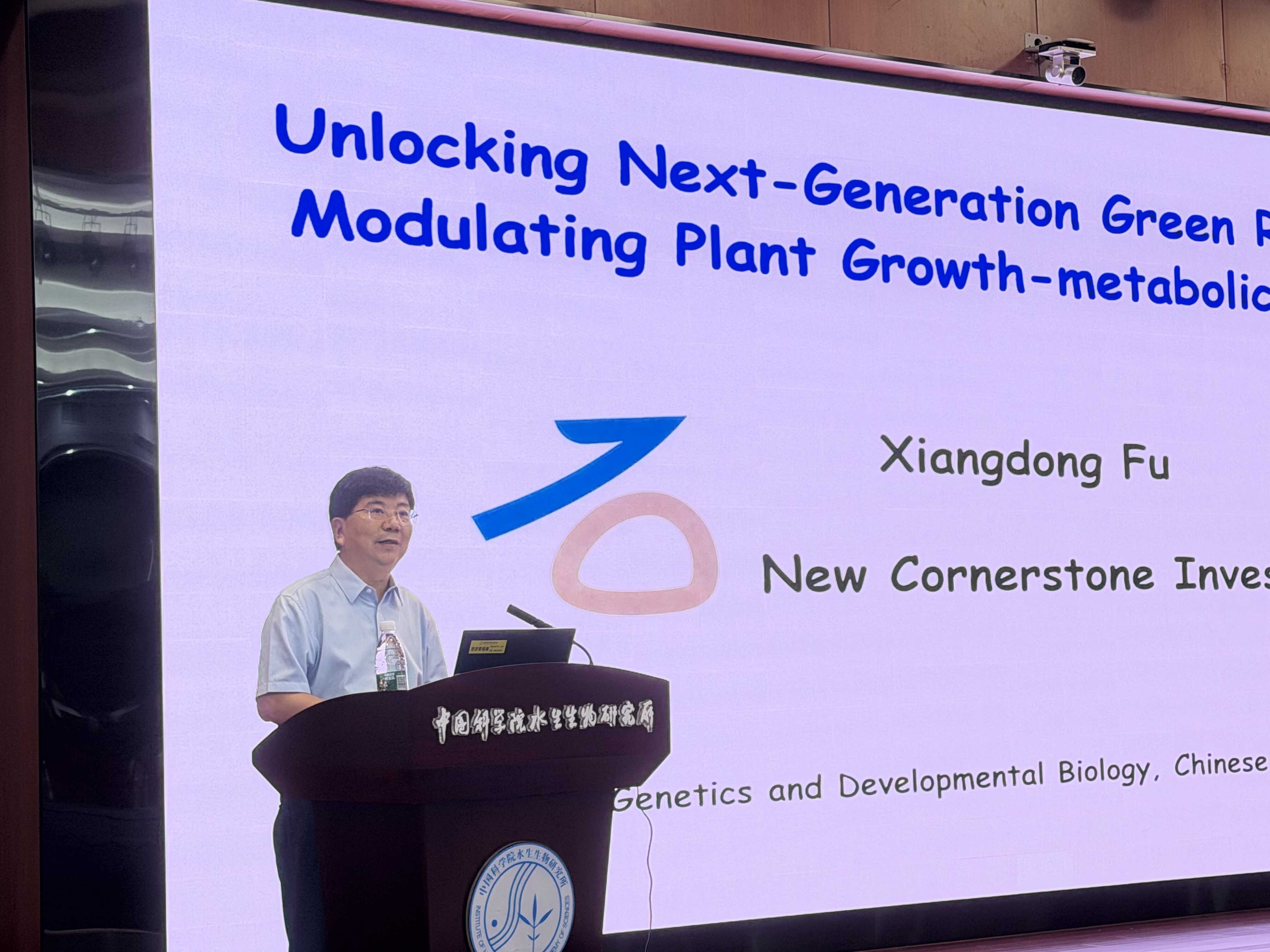
Prof. FU Xiangdong, an academician of the Chinese Academy of Sciences and director of the Institute of Genetics and Developmental Biology (IGDB), visited IHB for an academic exchange on June 30, 2026. (Credit: IHB)
On June 30, 2026, Prof. FU Xiangdong, an academician of the Chinese Academy of Sciences and director of the Institute of Genetics and Developmental Biology (IGDB), visited the Institute of Hydrobiology (IHB) of the Chinese Academy of Sciences for an academic exchange. He delivered a lecture entitled " Unlocking Next-Generation Green Revolutions by Modulating Plant Growth-metabolic Coordination ".
In his presentation, Prof. Fu presented his team's long-term research on the interplay between plant hormones and environmental signals, highlighting key breakthroughs in our understanding of the mechanisms that couple plant growth with metabolic regulation.
He traced the trajectory of the green revolution since the 1960s, noting that while semi-dwarf genes significantly improve lodging resistance, fertilizer-use efficiency, and global grain yields, they simultaneously created a heavy dependence on chemical fertilizers, leading to new agricultural and ecological challenges.
Building on this context, Prof. Fu described his team's systematic dissection of the regulatory network integrating gibberellins, other phytohormones, light signals, and nitrogen nutrition. They have elucidated how this network modulates plant development and carbon‑nitrogen metabolism under fluctuating environmental conditions.
Through precise modulation of key genes in the gibberellin signaling pathway, his team has successfully achieved synergistic optimization of carbon metabolism and nitrogen-use efficiency without compromising yield. This work provides a novel strategy to resolve the trade‑off between heavy fertilization and environmental pressure, offering significant implications for sustainable agriculture and future food security.
The lecture attracted great interest, sparking in‑depth discussions on topics such as the adaptability of new bred rice varieties to varying soil fertility, their effects on soil microbial colonization, allelic variation phenotypes in rice traits, and the application of AI‑enhanced breeding technologies.
Prof. Fu is director of the National Key Laboratory of Seed Innovation, a founding "New Cornerstone Investigator," a recipient of both the National Science Fund for Distinguished Young Scholars, and the National High-Level Talents Special Support Plan (the WR Plan). His research has long focused on hormonal regulation of plant development and environmental adaptation. He has published over 100 papers in journals including Nature, Science, and Nature Genetics, and has been repeatedly named among the world's top 1% most highly cited scientists.
His achievements have been recognized as part of China's Top 10 Scientific Advances (2018), China's Top 10 Life Science Advances (2020), and China's Top 10 Agricultural Science Advances (2019 and 2021). He has received the second prize of the National Natural Science Award, the National Innovation Excellence Award, the CAS Outstanding Scientific and Technological Achievement Award, and the Tan Jiazhen Life Science Innovation Award, among others.