Newsroom
LIANG Zhice's Doctoral Dissertation Selected as Outstanding Doctoral Dissertation of Chinese Academy of Sciences
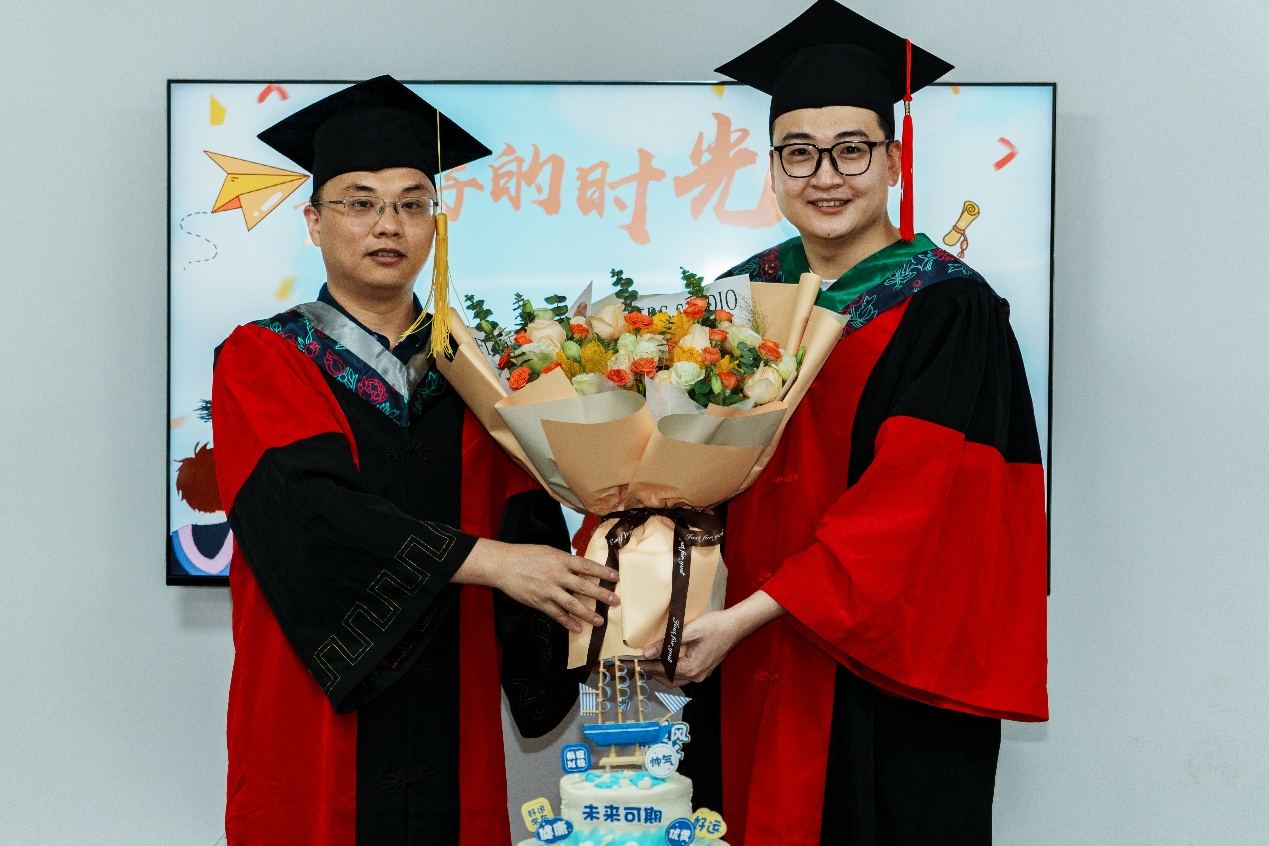
LIANG Zhice (R) and his supervisor Prof. GUO Chuanbo (Credit: IHB)
The list of the 2026 Outstanding Doctoral Dissertations of the Chinese Academy of Sciences (CAS) has recently been announced. The doctoral dissertation entitled " Mechanisms Underlying the Impacts of Representative Human Activities on Lake Fish Multidimensional Diversity: Evidences from Research Across Diverse Spatiotemporal Scales," completed by LIANG Zhice, a 2025 Ph.D. graduate of the Institute of Hydrobiology (IHB) of the Chinese Academy of Sciences, has been selected as a CAS Outstanding Doctoral Dissertation.
Liang conducted his doctoral research under the supervision of Prof. GUO Chuanbo. He entered IHB after graduating from Hainan University in 2021. From January 2024 to March 2025, he carried out joint doctoral training at the University of Toronto upon invitation from the university and with sponsorship from the China Scholarship Council. He received his Ph.D. degree in June 2025. During his doctoral studies, his research focused on the mechanisms by which representative human activities influence the multidimensional diversity of lake fish communities, systematically revealing how human-induced disturbances reshape fish community structure and ecosystem functioning from multiple perspectives.
Human activities are profoundly altering biodiversity patterns in freshwater ecosystems worldwide. Previous studies have largely focused on taxonomic diversity while overlooking functional and phylogenetic dimensions, limiting a comprehensive understanding of the mechanisms driving biodiversity loss. By constructing integrated databases across multiple spatial and temporal scales, Liang's dissertation combined taxonomic, functional, and phylogenetic information to comprehensively investigate how representative human activities affect the multidimensional diversity of lake fish communities and ecosystem functioning. The major findings have been published in leading international journals, including Global Change Biology (two papers), Journal of Applied Ecology (accepted), Ecological Informatics, and Ecosphere.
The dissertation achieved a series of original advances in both theory and methodology. First, it developed a Composite Diversity Index (CDI) integrating taxonomic, functional, and phylogenetic information, overcoming the limitations of conventional biodiversity assessments based solely on species diversity. Second, it proposed and validated a dynamic Convergence–Divergence–Convergence (CDC) framework for fish community assembly, extending community assembly theory from static patterns to dynamic processes. Building upon these advances, the dissertation further established a framework for fish community regulation aimed at ecological restoration and ecosystem function enhancement, elucidating the mechanisms through which the synergistic implementation of passive conservation (e.g., freshwater protected areas) and active management (e.g., targeted fish removals) regulates fish community structure and ecosystem functioning. These findings not only enrich and advance the theoretical framework of multidimensional biodiversity and community assembly in freshwater fishes but also provide practical theoretical guidance and technical approaches for biodiversity conservation and ecological restoration.
The CAS Outstanding Doctoral Dissertation Award recognizes doctoral theses that address frontier scientific questions with originality and pioneering significance, make important theoretical or practical contributions, achieve innovations in theory or methodology, advance scientific research within their disciplines through breakthrough findings, and reach a leading level nationally or an advanced level internationally. Award-winning dissertations must also demonstrate rigorous academic standards, comprehensive and reliable supporting evidence, sound scientific reasoning, precise academic writing, and clearly reflect the author's rigorous scientific integrity and strong capacity for conducting independent research.