Newsroom
Two Major Research Outcomes Signed at IHB, Totaling RMB 110 Million
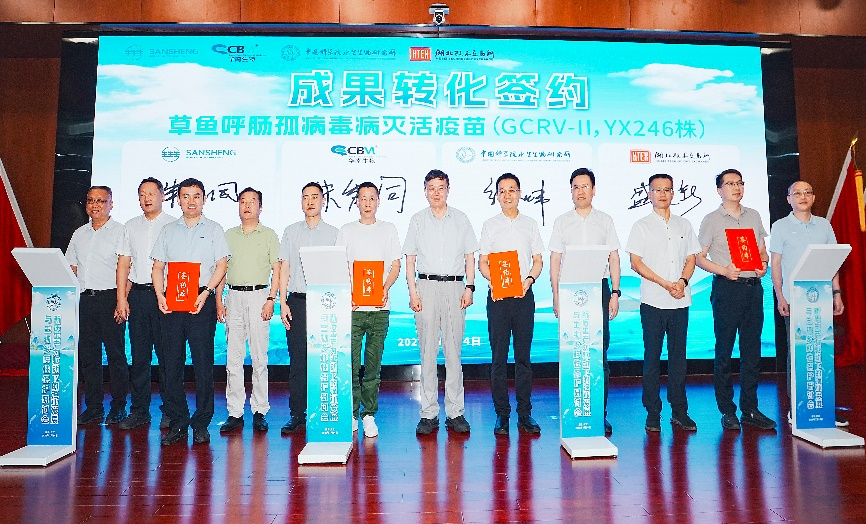
A signing ceremony was held for the Grass Carp Reovirus (GCRV-II) Inactivated Vaccine project. (Credit: IHB)
On July 14, 2026, the Institute of Hydrobiology (IHB) of the Chinese Academy of Sciences hosted a symposium on fishery development and biodiversity conservation driven by new quality productive forces. The event brought together government officials, researchers and industry partners. IHB director MIAO Wei, deputy directors XIE Shouqi, XU Jun and XU Zhen attended the symposium.
The opening ceremony was chaired by XIE Shouqi. In his address, Miao Wei noted that 2026 marks the first year of the 15th Five-Year Plan, a year in which agricultural innovation has become a national priority. He stressed that the true value of scientific innovation lies in its translation into practical applications, and that the two projects to be signed exemplified IHB's commitment to bridging the gap between research and industry.
ZHAO Xingang, speaking on behalf of the CAS Bureau of Science and Technology for Sustainable Development, added that fishery science must embrace cross-disciplinary integration with life sciences and information technology. He expressed his hope that IHB would continue to deliver breakthroughs in both fundamental research and key technologies, providing stronger scientific support for the high-quality development of China's fishery sector.
Following the opening ceremony, two technology transfer agreements were formally signed, with a combined value of RMB 110 million.
The first, valued at RMB 80 million, is a Grass Carp Reovirus (GCRV-II) Inactivated Vaccine, developed by IHB and the State Key Laboratory of Breeding Biotechnology and Sustainable Aquaculture. The research team broke through the technical bottleneck of establishing GCRV-II-sensitive cell lines, creating the first inactivated vaccine against GCRV-II in China and globally. With an 80% immune protection rate demonstrated in laboratory trials, the vaccine is expected to significantly reduce grass carp mortality and boost aquaculture productivity. The technology will be jointly commercialized by Ringpu Bio and Ningbo Sansheng Biological Technology.
The second, valued at RMB 30 million, is an Underwater Cetacean Intelligent Early Warning and Deterrence Technology, an integrated system combining underwater monitoring, intelligent early warning and data traceability. The technology enables the coordinated protection of rare aquatic species during waterway construction. It has already been successfully applied in the Tongling G3 Yangtze River Rail-Road Bridge project and has been designated as a mandatory protection measure for the Three Gorges New Waterway Project. Guangxi New Harbour Engineering will lead its industrial application.
The academic session was chaired by deputy director XU Jun. Prof. GUI Jianfang presented on paradigm shifts driving high-quality fishery development and new quality productive forces. Prof. XU Zhen presented on infection mechanisms and immunological control of grass carp reovirus. Prof. MEI Zhigang reported on advances in theory, technology and innovation for Yangtze finless porpoise conservation.
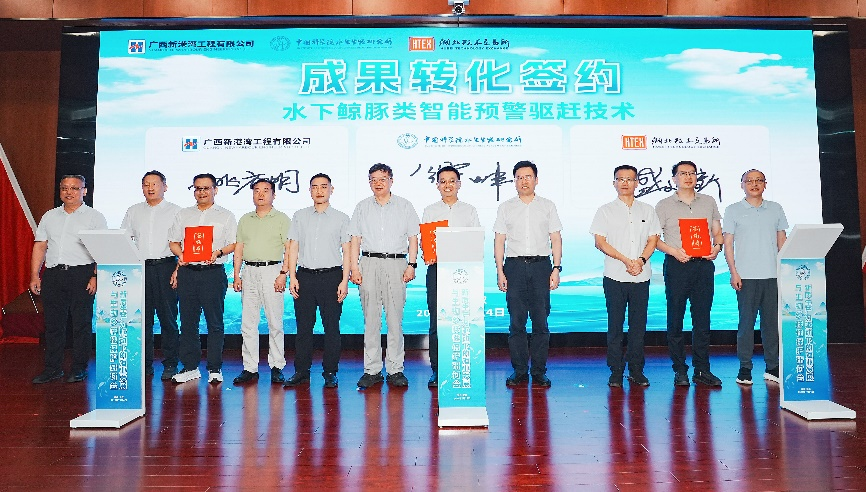
A signing ceremony was held for the Underwater Cetacean Intelligent Early Warning and Deterrence Technology project. (Credit: IHB)