Newsroom
IHB and East Lake Scenic Area Hold Symposium on Coordinated Development
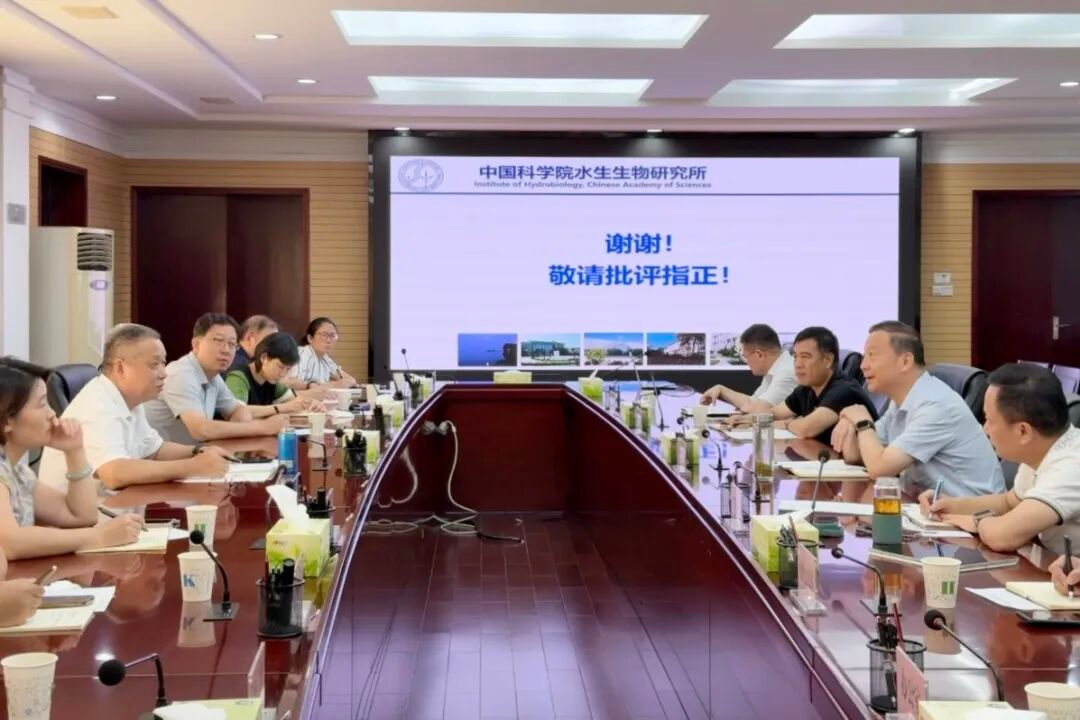
IHB and the East Lake Scenic Area held a symposium on August 26, 2026 to explore coordinated development in ecological improvement, cultural and tourism upgrading, and science-education integration. (Credit: IHB)
The Institute of Hydrobiology (IHB), Chinese Academy of Sciences, and the East Lake Scenic Area held a symposium on August 26, 2026 to explore coordinated development in ecological improvement, cultural and tourism upgrading, and science-education integration. The two sides agreed to deepen cooperation in lake governance, research commercialization, and AI-enabled ecological protection.
Zhang Jin said IHB has long been an important scientific and technological support for East Lake's protection and development. He outlined three priorities for cooperation: fully supporting the construction of the National Research Center for Yangtze Finless Porpoise Breeding and Conservation, promoting research commercialization in water, fisheries, and algae to strengthen the water economy, and using AI to build an intelligent East Lake simulator.
Xie Shouqi, deputy director of IHB, said the institute will deepen cooperation and data sharing with the scenic area, integrate the strengths of the entire institute, and translate research results into practical benefits for East Lake's ecological governance and cultural-tourism development.
At the meeting, SONG Chunlei, head of the Office of Research and Technology Development of IHB, presented the institute's progress in East Lake algal bloom control, aquatic ecological restoration, fishery regulation, finless porpoise conservation, recreational fisheries, and aquatic biodiversity databases and intelligent monitoring, and proposed key areas for potential cooperation.
Representatives from relevant functional departments of the scenic area exchanged views with IHB researchers on ecological protection, lake governance, and resource utilization, and discussed key and difficult issues in their practical work.
The meeting was also attended by IHB researchers and heads of relevant functional departments.