Newsroom
IHB Signs Strategic Cooperation Agreement with Shenzhen University of Advanced Technology
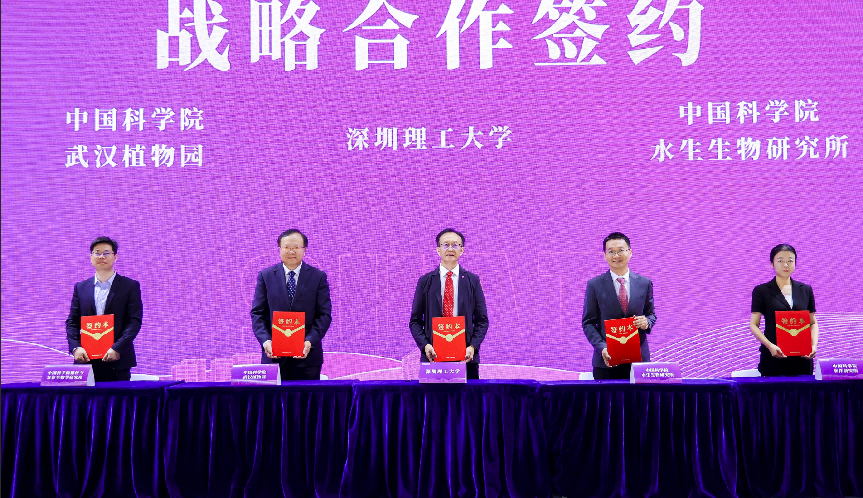
IHB signed a strategic cooperation agreement with Shenzhen University of Advanced Technology on Sept. 29, 2026. (Credit: IHB)
On September 29, 2026, the Shenzhen University of Advanced Technology (SUAT) held its opening ceremony for the 2026 academic year and a strategic cooperation signing event. MIAO Wei, director of the Institute of Hydrobiology (IHB) of the Chinese Academy of Sciences, attended at the invitation and signed a strategic cooperation framework agreement on behalf of the institute.
Under the agreement, the two sides will pursue comprehensive and in-depth cooperation in disciplines, research, education, talent training, platform sharing and technology transfer, guided by the principles of complementary strengths, resource sharing, mutual benefit and coordinated development.
The partnership will combine IHB's expertise and research base in hydrobiology, freshwater aquaculture and water environment ecology with SUAT's disciplinary layout and innovation mechanisms as a new-type research university, with the aim of exploring new models of integrating research and education and advancing high-level research collaboration and joint training of top-tier talent.
In the afternoon, IHB's head of graduate education attended a forum hosted by SUAT on the development of engineering master's and doctoral programs. The event brought together graduate education leaders from SUAT, several CAS institutes and companies including BGI to discuss admissions, training and student management for engineering master's and doctoral programs.
The agreement is seen as a major arrangement by both institutions, each building on its own positioning, in response to national needs for ecological conservation and frontier research. The two sides said they will use the partnership to explore an effective model for collaboration between research institutes and new-type research universities, supporting the training of high-level basic research talent and breakthroughs in core technologies in the aquatic sciences.