Newsroom
Climate Shifts Reshape Nitrogen and Phosphorus Redistribution in China's Inland Waters
Nitrogen (N) and phosphorus (P) pollution remains a persistent threat to aquatic ecosystems. Although both nutrients are often managed together, they differ substantially in their sources, transport pathways, and biogeochemical transformations, and how climate shifts reorganize their distributions across large and diverse inland-water networks has remained poorly understood.
Recently, a research team led by Prof. BI Yonghong from the Institute of Hydrobiology (IHB) of the Chinese Academy of Sciences, with first author LI Yuan from Taiyuan University of Science and Technology, uncovered the climate-driven decoupling of nitrogen and phosphorus redistribution patterns in China's inland waters. The study was published in Environmental Research.
The researchers compiled 117,212 quality-controlled monthly observations from 3,646 monitoring stations covering rivers, reservoirs, lakes, and estuaries between 2021 and 2023, and combined seasonal comparisons, empirical Bayesian kriging, hotspot analysis, and climate–nutrient models to characterize contemporary patterns and project responses under the SSP2-4.5 climate scenario.
They found that N and P followed contrasting spatial logics. N concentrations averaged 2.57 ± 2.66 mg L-1 and were highest in northern basins, reaching 4.44 ± 5.29 mg L-1 in the Yellow River Basin, whereas P averaged 71 ± 66 μg L-1 and peaked in the Huai River Basin (97 ± 74 μg L-1).
N generally peaked in winter and P in summer, with the median molar N:P ratio 53% higher in winter than in summer; extreme hotspots overlapped in only 31.6% of the highest-decile sites. Under SSP2-4.5, projected warming and precipitation changes were associated with declining N but increasing P concentrations, reducing seasonal molar N:P ratios by approximately 19–36% by the mid- and late-century periods.
These results indicate that climate-conditioned N–P decoupling reflects a reorganization of seasonal timing, geographic hotspots, and nutrient stoichiometry rather than merely opposite mean trends.
The findings provide new insight into how climate shifts reshape nutrient risks across China's inland waters and offer a scientific basis for region-, season-, and nutrient-specific management of eutrophication.
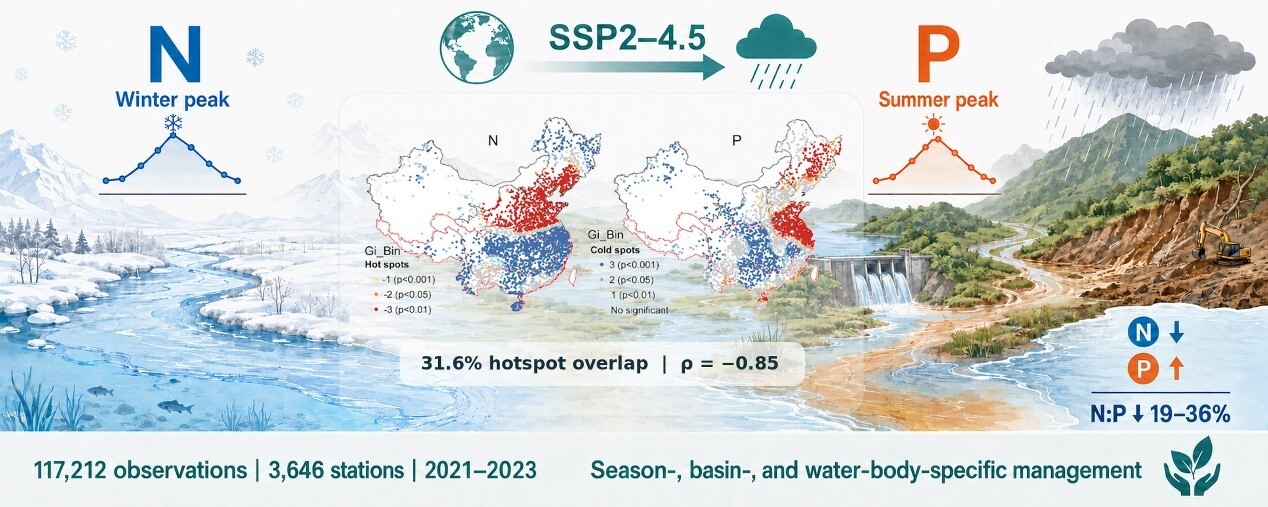
Climate shifts decouple nitrogen and phosphorus redistribution patterns in China’s inland waters, calling for season‑, basin‑ and water‑body‑specific nutrient management. (Image by IHB)
(Editor: MA Yun)