Newsroom
Study Uncovers Novel Role for Mitochondrial Antiviral Signaling Protein (MAVS) under Hypoxic Stress
Upon RNA virus infection, the mitochondrial antiviral signaling protein (MAVS) aggregates on the outer mitochondrial membrane and activates downstream transcription factors such as Interferon Regulatory Factor 3/7 (IRF3/7), leading to the production of type I interferons and other antiviral genes. As a central hub in the innate immune response to RNA viruses, MAVS is functionally conserved from fish to mammals. However, it remains unclear whether MAVS can sense and respond to non-infectious stressors, including low-oxygen environments.
A research group led by Prof. XIAO Wuhan from the Institute of Hydrobiology (IHB) of the Chinese Academy of Sciences has now uncovered a previously unrecognized function of MAVS under hypoxic conditions. The study has been published in Proceedings of the National Academy of Sciences of the United States of America (PNAS).
In this study, the researchers found that beyond viral infection, MAVS also responds to hypoxic stress by undergoing aggregation on mitochondria. The oligomerized MAVS facilitates the interaction between the E3 ubiquitin ligase Tumor Necrosis Factor Receptor-Associated Factor 6 (TRAF6) and Evolutionarily Conserved Signaling Intermediate in Toll Pathways (ECSIT), a critical factor for the assembly of mitochondrial complex I. This leads to polyubiquitination and activation of ECSIT, which enhances the production of mitochondrial reactive oxygen species (ROS). Elevated ROS, in turn, inhibits the enzymatic activity of prolyl hydroxylase Prolyl Hydroxylase Domain-Containing Protein 2 (PHD2), thereby stabilizing hypoxia-inducible factor α (HIF-α) and activating the hypoxia signaling pathway to orchestrate hypoxic adaptation and tolerance.
This study reveals a new function of MAVS in modulating hypoxia signaling under non-infectious conditions, offering new insights into the crosstalk between two ancient stress-responsive systems: the innate immunity signaling pathway and the hypoxia signaling pathway.
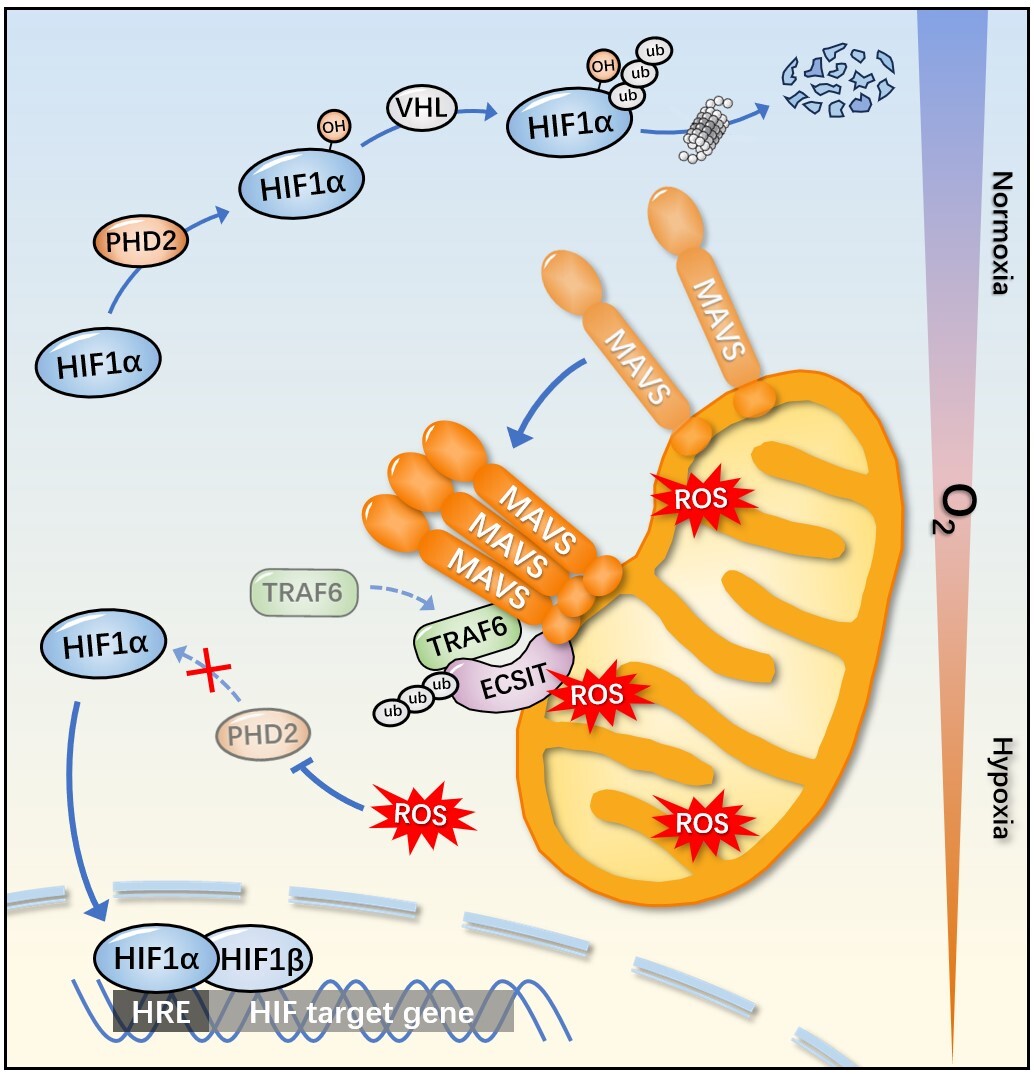
A working model for the role of MAVS under hypoxic conditions (Image by IHB)
(Editor: MA Yun)