Newsroom
Professors from University of Pennsylvania Visit IHB
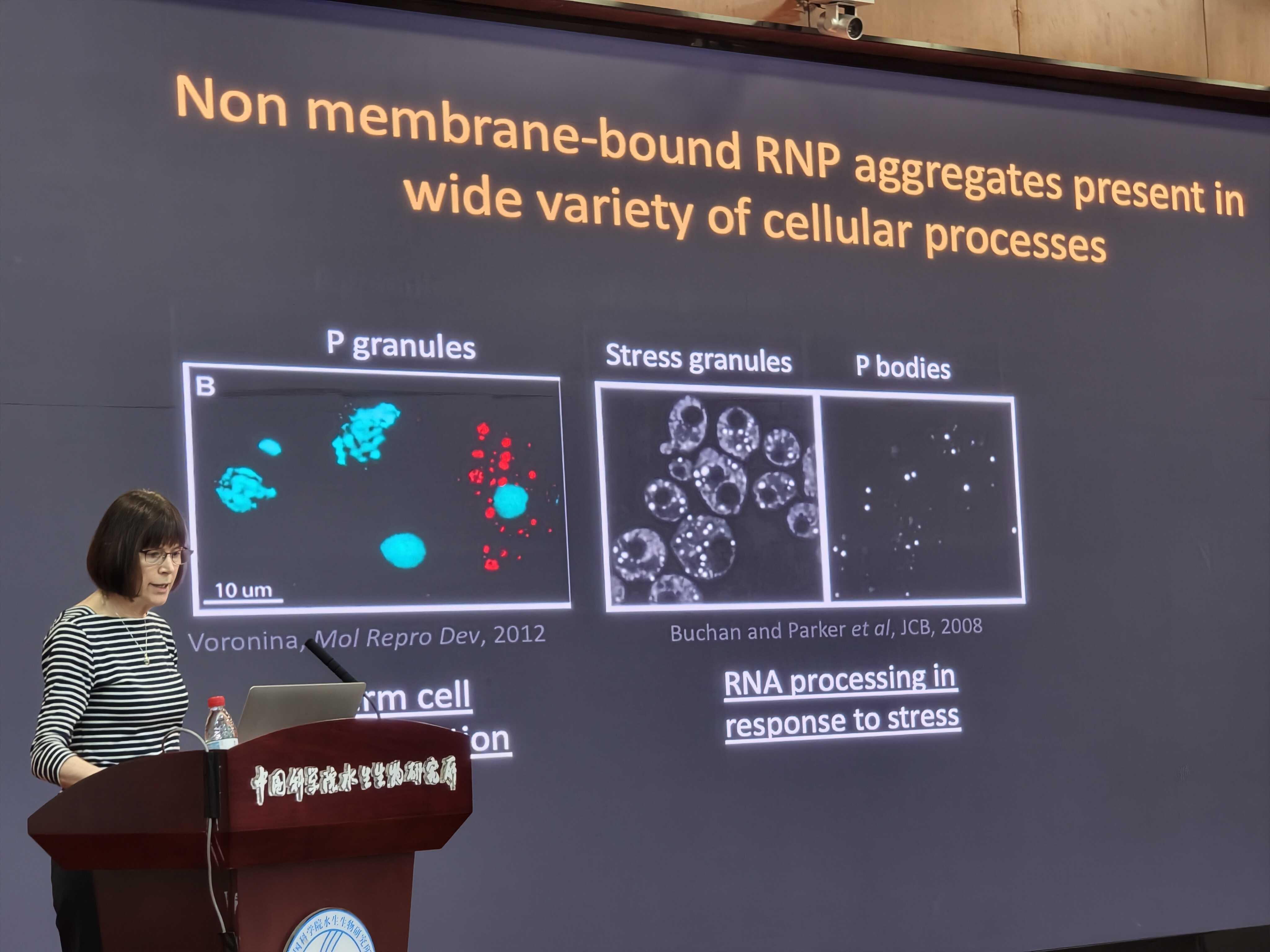
Dr. Mary Mullins, Professor in the Department of Cell and Developmental Biology at the Perelman School of Medicine, visited IHB on May 25, 2026. (Credit: IHB)
Two leading researchers from the University of Pennsylvania delivered invited lectures on May 25, 2026 at the Institute of Hydrobiology (IHB) of the Chinese Academy of Sciences, as part of the Institute's Innovation Series 2026.
Dr. Mary Mullins, Professor in the Department of Cell and Developmental Biology at the Perelman School of Medicine, and Dr. Michael Granato, Professor of Cell and Developmental Biology and Neuroscience, presented their latest findings to an audience of more than 100 IHB researchers and graduate students. The event was chaired by Prof. SUN Yonghua.
Prof. Mullins, former President of the International Zebrafish Society and an AAAS Fellow, spoke on “The role of Bucky ball and the Balbiani Body in oocyte polarity, the embryonic axes, and germ cell development.”
Using zebrafish as a model, Mullins detailed systematic studies on the role of Bucky ball (Buc) and the Balbiani Body (Bb) in establishing oocyte polarity, embryonic axes, and germ cell development. She highlighted the essential function of Buc in oocyte polarity formation. Notably, while the Balbiani Body is closely associated with oocyte polarity, her findings indicate it is not strictly required for establishing the animal-vegetal axis.
Mullins also presented evidence showing that high expression levels of the Buc protein, together with specific amino-terminal regions, are critical for Balbiani Body aggregation. These insights open new avenues for understanding early oocyte polarity and germ cell fate determination. Following the lecture, she engaged in a lively discussion with IHB faculty and students on topics ranging from oocyte polarity to germ cell regulation and zebrafish developmental biology.
Prof. Granato, recipient of the Friedrich Wilhelm Bessel Research Award from the Alexander von Humboldt Foundation, presented on “Cellular and Molecular Mechanisms of Spontaneous CNS Axon Regeneration.”
His research, also conducted in zebrafish, focuses on optic nerve regeneration. Using high-resolution live imaging, Granato demonstrated dynamic repair processes following optic nerve and spinal cord injury. He identified lh3, a glycosyltransferase involved in extracellular matrix modification, as a key player in guiding optic nerve axon regeneration.
Granato further shared recent advances from his team’s spinal cord research, highlighting the selective roles of huntingtin (Htt) and Celsr3 in promoting CNS axon regeneration. An in-depth exchange followed the talk, covering neural regeneration mechanisms, applications of zebrafish models, and cutting-edge technologies.
Prof. Mullins is a recipient of the Christiane Nüsslein-Volhard Award and the International Zebrafish Society’s George Streisinger Award. Her team has long investigated how BMP signaling pathways regulate cell fate decisions during vertebrate embryonic development and co-designed and executed the first large-scale forward genetic screen in zebrafish, greatly advancing molecular genetics in the field.
Prof. Granato is a recipient of the George Streisinger Award. Through large-scale mutant and small-molecule screens, his team has identified numerous previously unknown genes and pathways that govern CNS axon regeneration, habituation learning, and sensorimotor decision-making.
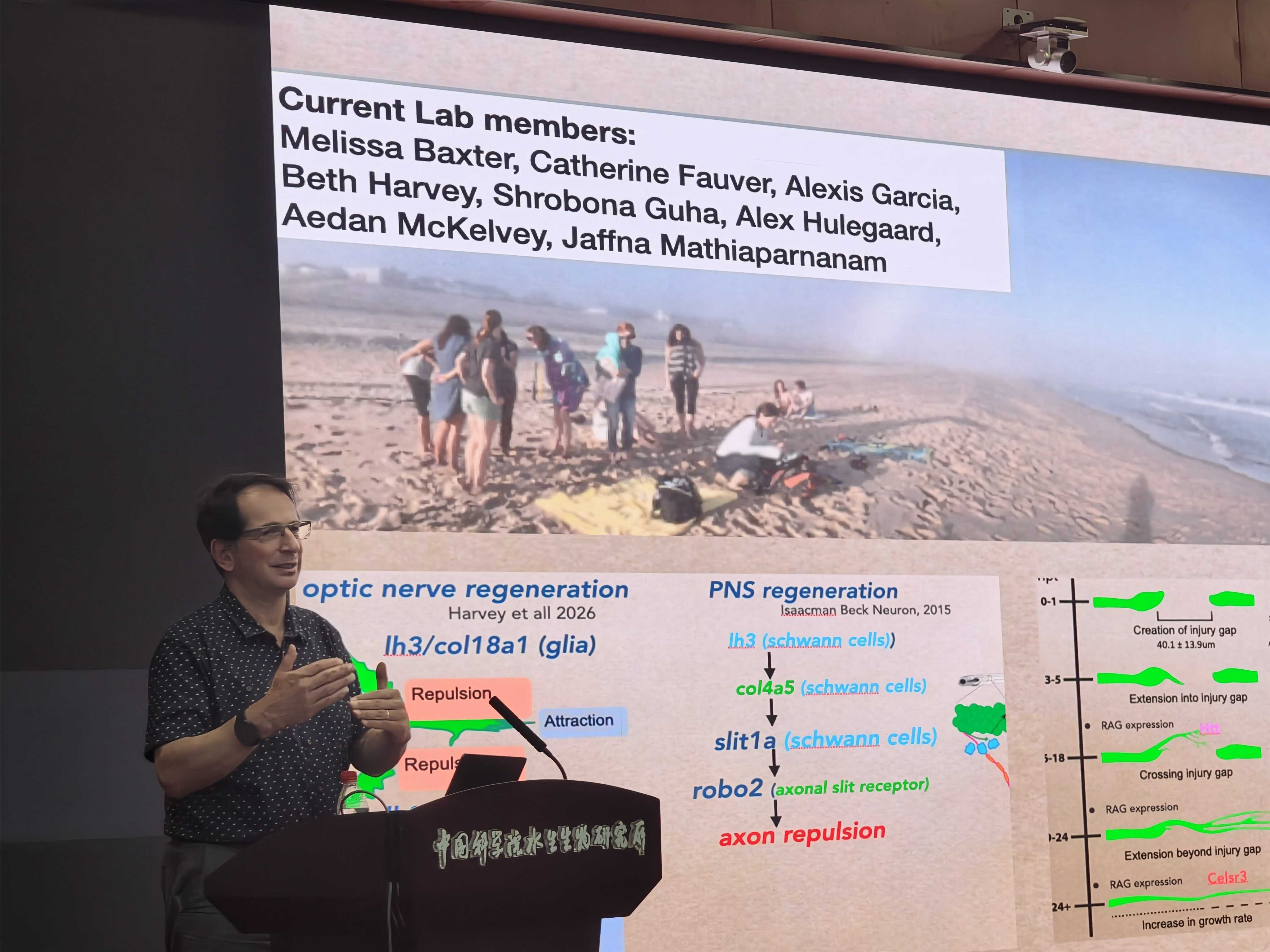
Dr. Michael Granato, Professor of Cell and Developmental Biology and Neuroscience, visited IHB on May 25, 2026. (Credit: IHB)