Newsroom
Professor Georg Pohnert from Friedrich Schiller University Jena Visits IHB
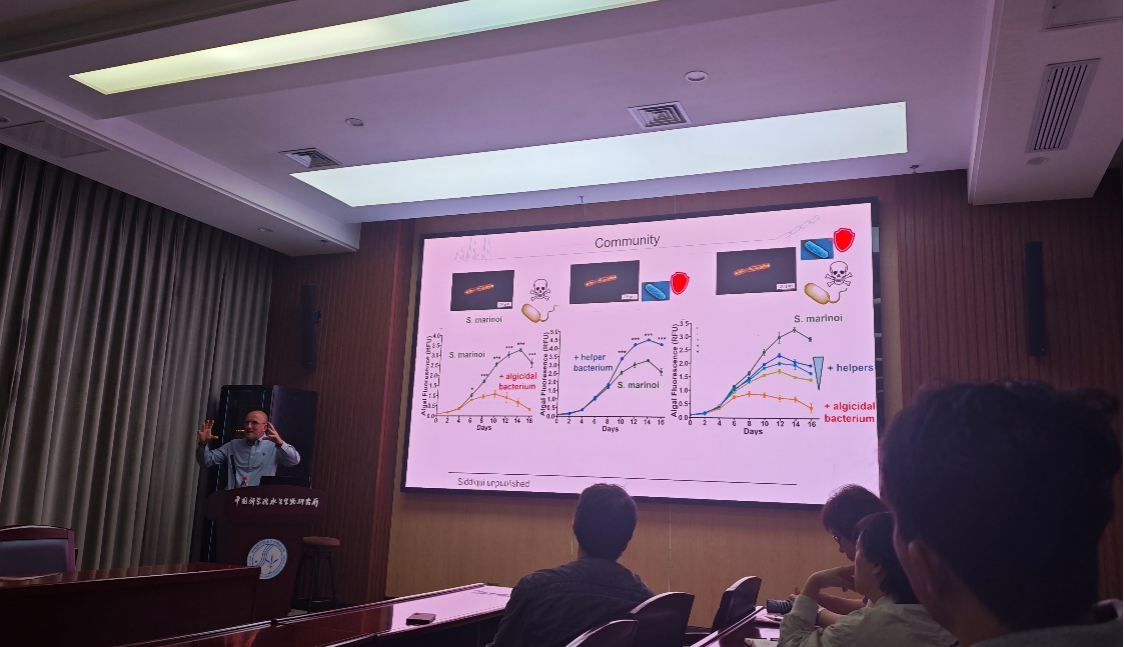
Professor Georg Pohnert from Friedrich Schiller University Jena, Germany, visited IHB on the morning of October 15, 2026. (Credit: IHB)
On the morning of October 15, 2026, Professor Georg Pohnert from Friedrich Schiller University Jena, Germany, was invited to visit the Institute of Hydrobiology (IHB) of the Chinese Academy of Sciences, and delivered an academic report titled "Induction of and Adaptive Responses to Coexisting Bacteria by Microalgae: Mechanisms Shaping Plankton Communities."
At the beginning of the lecture, Professor Pohnert introduced that marine microalgae contribute about half of global photosynthesis, and the algal blooms they form profoundly affect biogeochemical cycles; biological interactions between microalgae and bacteria dominate phytoplankton community succession. In recent years, his team has systematically elucidated the mechanisms of bidirectional chemical interactions between algae and bacteria: under conditions such as nutrient deficiency and senescence, microalgae undergo metabolic reprogramming and release signals and stress metabolites, including methionine-related substances, DMSP/DMSOP, reactive oxygen species, and oxidized lipids, via extracellular vesicles. These substances can regulate the physiology of coexisting bacteria as nutrients; after sensing algal chemical signals, bacteria can in turn regulate microalgal senescence and revival, jointly shaping plankton communities and driving marine biogeochemical cycles.
The research also found that DMSP is another core chemical pathway in algal-bacterial interactions and is coupled with the extracellular vesicle pathway: microalgae synthesize DMSP and oxidize it to DMSOP, both of which can be packaged in extracellular vesicles and released, serving as signaling molecules and carbon-sulfur substrates for bacteria. Coexisting bacteria can utilize algal metabolites to obtain carbon and sulfur nutrients. The discovery of DMSOP, the oxidized form of DMSP, has rewritten the accounting of the global sulfur cycle.
Professor Pohnert has long been deeply engaged in the chemical ecology of marine microalgae, focusing on molecular interactions between algae and the environment and techniques for natural product mining and characterization. His research directions cover planktonic toxin biosynthesis, metabolic regulation, chemotactic responses, chemical defense, and interspecies communication, with emphasis on elucidating chemical signal-mediated algal-bacterial interactions and their regulatory mechanisms in aquatic ecosystems.